If you scroll through any news feed today, you’ll find plenty of stories about anxiety, depression, and the loneliness epidemic gripping the Western world. What you won’t find as often is a story about one of the most consistently documented protective factors against all three — and it isn’t a new drug, an app, or a wellness trend. It’s something humans have practiced for millennia: religion.
In May 2026, the Wheatley Institute at Brigham Young University released a sweeping report titled “The Religion and Mental Health Connection,” and it has been making waves in both scientific and religious communities ever since. The report didn’t run a brand-new study with a few hundred participants. Instead, it did something far more ambitious: it synthesized thousands of existing medical and social-science studies to ask a simple but urgent question — does religious involvement actually help or hurt mental health?
The short answer, according to the data, is striking. Let’s dig into who produced this report, what it actually found, and why the topic of religion and mental health deserves a much closer look than the loud, polarized debates we usually see in the media.
Who Wrote the Religion and Mental Health Report?
This wasn’t the work of a single academic with a pet theory. The Religion and Mental Health Connection was produced by a multidisciplinary team assembled by the Wheatley Institute, a research center at Brigham Young University that focuses on family, religion, and civic institutions.
The lead author is Loren D. Marks, a Professor of Family Life at BYU who has authored more than 200 academic publications and co-directs the American Families of Faith project. Marks has spent decades studying the connection between religion and health, and in interviews about the report, he noted that he personally expected the ratio of positive-to-negative studies to be much closer than it turned out to be — yet the well-conducted research showed the benefits of religion were even more prevalent than he’d anticipated.
He was joined by an impressive bench of co-authors, each bringing a different angle of expertise:
- Harold G. Koenig, M.D. — professor of psychiatry and behavioral sciences at Duke University and founding director of Duke’s Center for Spirituality, Theology and Health. Koenig is one of the most cited researchers in the world on the intersection of religion and medicine.
- Shima Baradaran Baughman — the Woodruff J. Deem Professor of Law at BYU and a nationally recognized criminal justice scholar who studies how religious involvement helps people recover from substance abuse.
- W. Justin Dyer — Professor of Religious Education and editor-in-chief of BYU Studies, who researches the interplay between religion, family life, and mental health.
- Sam A. Hardy — a BYU psychology professor and leading researcher on moral and religious development.
- Paul W. Lambert — Director of the Religion & Human Flourishing Initiative at Wheatley, an expert on religious pluralism in society.
- Nicole Schraedel — a Wheatley Scholar and research assistant focused on religion and health.
This is the kind of author lineup that gives a report credibility well beyond a single university’s echo chamber — physicians, legal scholars, psychologists, and sociologists all converging on the same body of evidence.
Crucially, the report wasn’t built from scratch. It synthesizes findings catalogued in the landmark Oxford University Press Handbook of Religion and Health (2024), a reference work widely regarded as the most comprehensive compilation of religion-and-health research available. In other words, the Wheatley team didn’t cherry-pick studies — they distilled an entire field’s worth of peer-reviewed literature into one accessible report.
The Headline Number: A 10-to-1 Ratio
Here’s the figure that made headlines: among studies reporting positive associations between religious involvement and mental health (961) versus those reporting negative associations (101), the ratio was nearly 10 to 1.
That’s not a fringe statistic from one small sample — it’s a tally drawn from thousands of high-quality studies examining major mental health domains, including coping with stress, depression, anxiety, personality disorders, positive emotion, suicide, substance abuse and addiction, bipolar disorder, and schizophrenia.
Let’s break down some of the most eye-catching category-by-category findings.
Suicide
This is where the data is most dramatic. Of 76 high-quality studies examined, 89% found lower suicide rates among more religious individuals. Even more strikingly, researchers estimate that the long-term decline in weekly religious attendance may account for roughly 40% of the rise in the U.S. suicide rate.
One of the most fascinating “episodes” buried in this research comes from one of the largest long-running health studies in American medical history — the Nurses’ Health Study, which has tracked the lives of tens of thousands of women for decades. Within a cohort of nearly 110,000 health professionals, women who attended religious services weekly were found to be 75% less likely to die by suicide over a 16-year follow-up period, while men who attended weekly were 48% less likely to die by suicide over 26 years. Imagine being one of the researchers combing through decades of survey data and stumbling onto a pattern that consistent — it’s the kind of discovery that reshapes how an entire field thinks about prevention.
Anxiety
Of 85 high-quality studies examining anxiety, 69% reported lower anxiety levels among more religious participants. The mechanism researchers point to isn’t magic — it’s largely about belonging, ritual, and a coherent framework for processing uncertainty.
Depression
Of 247 high-quality studies on depression — one of the largest categories in the entire report — 74% found better outcomes among more religious individuals. A particularly compelling data point comes from a massive longitudinal study: among nearly 49,000 nurses tracked over 16 years, those who attended religious services weekly had a 25% lower probability of developing depression.
Positive Emotion
This may be the most uplifting category in the whole report. Of 251 high-quality studies, an overwhelming 93% reported positive correlations between religious involvement and life satisfaction, happiness, hope, self-esteem, and optimism.
Coping with Stress
Of 103 high-quality studies, 86% found a link between religious involvement and healthier stress-coping strategies — a finding the authors call especially relevant given how chronically stressed American life has become in recent years.
It’s Not Just “Being Religious” — It’s the Threshold Effect
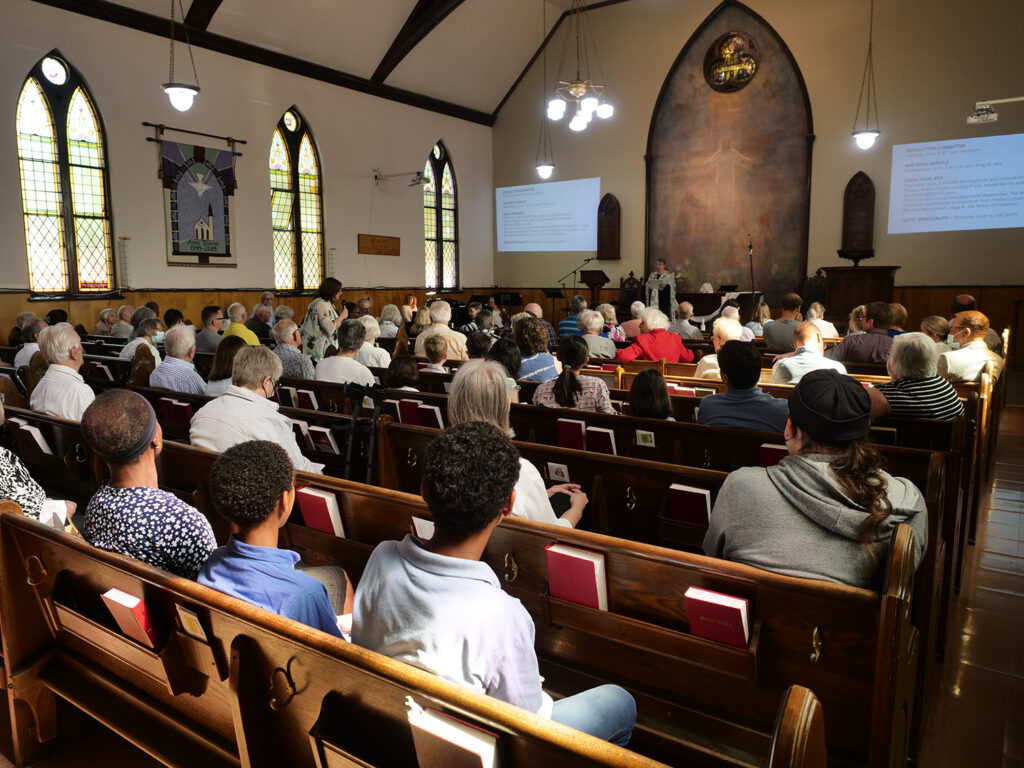
One of the more nuanced findings in the religion and mental health report is what the authors call a “threshold effect.” Simply checking a religious affiliation box on a survey doesn’t predict much on its own. The report instead finds that the benefits of religion converge among those with sustained, high engagement — typically weekly or more frequent worship attendance — and that this pattern holds from adolescence through older adulthood, and across racial, ethnic, and faith-tradition lines.
As the authors put it directly: “It is not nominal affiliation but committed religious involvement that appears to matter most.” In plain terms, showing up occasionally on holidays isn’t where the data shows the strongest effect — it’s consistent, ongoing participation in a faith community.
Why Is This Report Coming Out Now?
The timing isn’t accidental. Today, roughly 80% of Americans say religion is losing influence in American life, a perception backed by sociological data. Sociologist Christian Smith’s 2025 book Why Religion Went Obsolete: The Decline of Traditional Religion documents this shift in detail, and one striking international comparison the Wheatley report cites found that the United States now ranks roughly 14% lower in religiosity than formerly communist Russia — a genuinely surprising reversal that underscores just how fast American religious life has changed.
The Wheatley researchers argue that as religious commitment has declined, many Americans have quietly substituted it with intense devotion to politics, pop culture, or ideology — without necessarily gaining the same psychological benefits. The report’s authors frame their work as an attempt to counter polarized, sensationalized media narratives about religion with a sober look at what rigorous scientific data actually shows.
The Report Doesn’t Ignore the Dark Side
To its credit, the report isn’t a one-sided cheerleading exercise. The authors explicitly acknowledge that harmful or coercive forms of religion do exist — high-control groups, spiritually abusive leadership, and communities that weaponize guilt or shame can clearly damage mental health. The claim isn’t that every religious experience is automatically therapeutic. It’s that, when you zoom out across nearly a thousand studies, the overall pattern tilts heavily positive.
This is an important distinction for readers to hold onto. Following the report’s release, outlets like the Associated Press ran more cautious headlines questioning whether frequent worship leads to better mental health “often, but not always” — a fair reminder that correlation isn’t the same as a guarantee for every individual or every congregation.
Beyond Mental Health: What’s Coming Next
This mental health report is only the first of a three-part series on religion and human flourishing. Part two, The Religion and the Physical Health Connection, examines measurable physical health outcomes, and early findings are just as eye-opening: the analysis suggests that attending religious services frequently could be associated with living an average of 7.6 years longer — and as much as 13.7 years longer among African American attendees specifically. The same body of research found religious individuals were less likely to smoke or suffer a stroke, and more likely to show healthy immune function and hormone balance.
Part three of the series will turn to religion’s connection to social health — things like marriage stability, community ties, and civic trust.
What the Authors Recommend
The Wheatley team doesn’t stop at description — they offer concrete, policy-relevant suggestions for how this research could be applied:
- Treat religious participation as a legitimate complement to professional mental health treatment, not a replacement for it.
- Build referral pathways so that doctors and therapists can connect willing patients with supportive faith communities.
- Equip congregations to partner in suicide and substance-abuse prevention, particularly in rural or underserved areas where mental health resources are scarce.
- Protect religious freedom and pluralism, since the report’s authors argue these benefits depend on people being free to practice their own faith traditions without coercion in either direction.
The Bottom Line
What makes The Religion and Mental Health Connection compelling isn’t a single dramatic statistic — it’s the sheer breadth of evidence behind it. When researchers from Duke, BYU, and beyond comb through nearly a thousand high-quality studies and find a consistent 10-to-1 pattern favoring religious involvement across suicide risk, depression, anxiety, stress, and emotional well-being, it’s hard to dismiss as coincidence or bias from a single institution.
At the same time, the report is a reminder that nuance matters. The benefits the data shows are tied to committed, community-based religious participation — not nominal labels — and the authors are careful to acknowledge that harmful expressions of religion exist too. For anyone trying to understand the real relationship between religion and mental health in 2026, this report is one of the most thorough, evidence-based starting points available today.
Sources
- Wheatley Institute, “The Religion and Mental Health Connection” — full report and press release
- PR Newswire, “New Decades-Long Research Analysis Finds Religion Improves Mental Health By a 10-to-1 Margin”
- KSL.com, “Consistent religious involvement has a positive impact on mental, physical and social health”
- Wheatley Institute, “The Religion and the Physical Health Connection”
- Religion Unplugged, “Science Says Religion Is Good For Your Mental Health”
- Associated Press, “Does frequent worship lead to better mental health? Often, but not always, experts say”