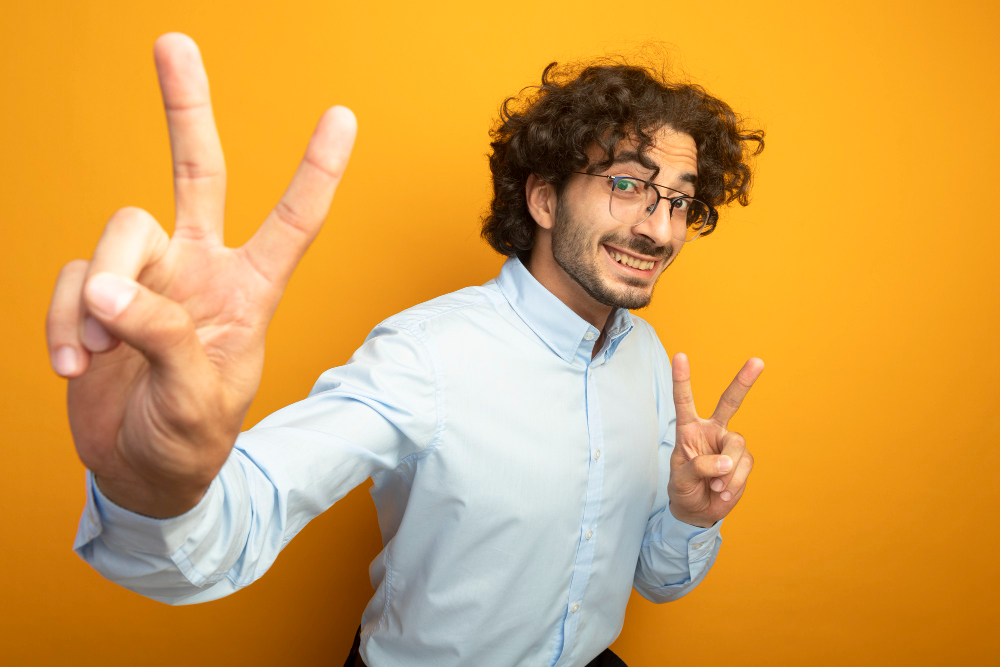
You’ve done it thousands of times without a second thought. Two fingers up, a bright smile, click — the perfect selfie. But what if that single casual gesture was quietly handing your most permanent personal identifier to anyone with the right software and a sharp enough image? That’s exactly the warning that has just emerged from Hong Kong’s South China Morning Post (SCMP), and it deserves far more attention than it’s getting.
This isn’t a conspiracy theory or tech-world scaremongering. It is a documented, verified, and increasingly urgent security concern sitting at the crossroads of AI advancement, high-resolution smartphone cameras, and the way billions of people photograph themselves every single day. The keyword at the center of all of this: V-pose fingerprint exposure — and by the time you finish reading, you’ll never look at a peace sign the same way again.
📰 The SCMP Report — What Was Actually Said
In May 2026, Hong Kong media outlet SCMP reported on a striking demonstration aired on a Chinese reality TV program. Financial security expert Li Chang used real celebrity selfies as case studies, showing exactly how clearly fingers appear in high-resolution photos — and how those same images can put personal biometric data at serious, tangible risk. Insight
According to Li Chang’s analysis, when a person’s fingers are pointed directly toward the camera and the photo is taken within approximately 1.5 meters, there is a high likelihood that fingerprint ridges will be captured with enough clarity for reconstruction. He further claimed that even photos taken from around 3 meters away could allow partial recovery of fingerprint details. Sedaily
What elevated the demonstration from theory to reality was what came next. The program publicly revealed the process of enhancing low-resolution images using photo editing tools combined with AI technology. Finger regions that were initially too blurry to identify became sharply defined — with distinctive fingerprint ridge patterns clearly emerging — after magnification and AI-assisted sharpness enhancement. Sedaily
This is the crux of the V-pose fingerprint exposure problem: it’s no longer about whether the original photo is high quality. AI can now compensate for what the camera couldn’t capture.
🔬 Expert Voices — What Specialists Are Saying About V-Pose Fingerprint Risk
Professor Jing Jiu of the University of Chinese Academy of Sciences, a specialist in cryptography, issued a clear warning: “With the widespread adoption of high-resolution cameras, it has become technically possible to reconstruct detailed hand information — including fingerprints — from nothing more than a V-pose photograph.” Mt
That is a remarkable statement from an academic institution of that caliber, and it carries significant weight. But experts are careful not to overstate the immediacy of the threat either.
Reconstruction requires multiple conditions to align simultaneously — adequate lighting, correct focus, sufficient image resolution, and an appropriate shooting angle. Not every selfie with a V-pose is an immediate security emergency. The danger, however, lies in a trend that makes those conditions increasingly easy to meet: smartphone cameras now routinely exceed 50 megapixels, AI upscaling tools are freely available, and people post the same poses across multiple platforms — giving anyone determined enough multiple angles to work with. Sedaily
💬 “If fingerprint data is replicated, it can be weaponized not only for financial fraud but for full identity theft. You should blur the hand area before uploading any photo to the internet.” — Li Chang, Financial Security Expert
The phrase V-pose fingerprint exposure may sound like a niche technical concern. It is not. It is a mainstream risk hiding in one of the most common human gestures on the internet.
✅ Rigorous Fact-Check — Separating Reality From Hype
Because this topic is prone to both dismissal and exaggeration, it’s worth examining each major claim with precision.
✅ VERIFIED: Extracting fingerprint data from high-resolution photos is technically possible
This is not a 2026 discovery. It was demonstrated publicly more than a decade ago and has been confirmed repeatedly since. The Chinese Academy of Sciences professor’s statement is consistent with the established scientific record. This claim is solid.
⚠️ PARTIALLY TRUE: A single selfie can instantly produce a perfect fingerprint clone
Instantly producing a perfect fingerprint replica from one selfie alone is not realistically straightforward. Criminal exploitation would require a high-resolution original image, photographs from multiple angles, and a meticulous AI-assisted enhancement process. The risk is real but not automatic — conditions and effort are still required. Sedaily
✅ VERIFIED: AI technology can compensate for low image quality
This was demonstrated live on the TV program itself, and it reflects a genuine capability of modern AI image enhancement tools. Super-resolution AI models, several of which are freely available online, can recover detail from images that would previously have been considered too degraded to be useful.
✅ VERIFIED: Fingerprints, once exposed, cannot be changed
Unlike passwords, fingerprints are extremely difficult to change once leaked, placing them among the most sensitive categories of personal data. This is the single most important reason why V-pose fingerprint exposure deserves serious attention. Every other credential you own can be reset. This one cannot. Sekye
⚠️ EXAGGERATED: Every V-pose photo guarantees fingerprint theft
This framing is too absolute and not supported by the evidence. Lighting, angle, resolution, and distance all matter. The risk exists on a spectrum, and understanding that spectrum is more useful than blanket fear.
🕰️ This Was Already Coming — A Timeline of Fingerprint Security Breaches
The SCMP report did not arrive in a vacuum. The vulnerability of fingerprint data has been documented for years, through some genuinely astonishing real-world cases.
🇩🇪 2014 — A Government Minister’s Fingerprint Cloned From Press Photos
At the Chaos Computer Club (CCC) annual conference in Hamburg, German hacker Jan Krissler — operating under the alias “Starbug” — demonstrated that he had successfully replicated the fingerprint of German Defense Minister Ursula von der Leyen. His tools were a handful of high-resolution official press photographs and a commercially available fingerprint recognition program called VeriFinger. Huffington Post
The irony is almost poetic: the photographs distributed by the government’s own press office became the attack surface. After Krissler’s presentation, security advisories quietly circulated among European politicians recommending that fingertips be kept out of official photographs — a precaution that, a decade later, the general public is only just beginning to hear about.
🇺🇸 2015 — 5.6 Million Federal Employees Lose Their Fingerprints Forever
The U.S. Office of Personnel Management suffered a catastrophic breach when a sophisticated APT attack — widely attributed to a Chinese hacker group — resulted in the theft of fingerprint records belonging to 5.6 million current and former federal government employees. Blogger
Think carefully about what that means. Those 5.6 million people cannot get new fingerprints. They cannot reset them, revoke them, or replace them. Every fingerprint-authenticated system they use for the rest of their lives carries a shadow of potential compromise. It remains one of the most consequential biometric data breaches in history.
🖨️ 2016 — A Standard Office Printer Defeats Smartphone Fingerprint Security
Researchers at Michigan State University achieved something that sounds impossible: they bypassed fingerprint authentication on top-of-the-line smartphones using fake fingerprints produced by an ordinary 2D inkjet printer loaded with silver conductive ink. No exotic equipment. No classified technology. The assumption that “fingerprint recognition equals reliable security” began to fracture publicly.
🇰🇷 2021 — South Korea’s Silicone Fingerprint Crime Wave
In South Korea, a criminal group was apprehended after attempting to execute a fraudulent land transaction on Jeju Island using silicone fake fingerprints under another person’s identity. Separately, military doctors and firefighters were caught falsifying attendance records using the same silicone fingerprint technique. Sekye
What makes the Korean cases notable is their ordinariness. This wasn’t state-level espionage or elite hacking — it was everyday fraud, executed with silicone molds. V-pose fingerprint exposure feeds directly into this ecosystem of relatively accessible biometric crime.
(Image: The concept of digital privacy and personal data protection — increasingly relevant as biometric data becomes a primary target for identity fraud. Source: Unsplash / general stock, for illustrative purposes)
😮 The Episodes That Make This Even More Unsettling
Beyond the documented cases, there are several stories circulating in security and tech communities that illustrate just how deep this rabbit hole goes.
🤳 Some Celebrities Figured It Out Years Ago — Quietly
In the mid-2010s, security-conscious sources in the South Korean and Japanese entertainment industries began quietly advising high-profile clients to avoid letting their fingertips face the camera directly in fan sign events and press photos. Some performers began curling their fingers slightly or clasping their hands when posing. At the time, observers assumed it was an aesthetic choice or a personal quirk. It was, in fact, a security precaution — one that the broader public is only now being advised to adopt.
📹 A Password Stolen From 44 Meters Away
In 2014, researchers at the University of Massachusetts demonstrated something that reframes the entire discussion around visual privacy: by recording a person entering a PIN from approximately 44 meters away, they were able to determine the password from video footage alone. No hacking, no malware — just a camera and some patience. If your password can be stolen from across a parking lot, the idea that your fingerprint is safe in a close-up selfie deserves serious scrutiny.
🔐 The Password You Can Never Change
Here is a thought experiment that security professionals sometimes use to explain the stakes: imagine you are given a password at birth, and you are told that you must use this same password for every important account, device, and building you will ever access for the rest of your life — and that you are never, under any circumstances, allowed to change it. That is exactly the situation with your fingerprint. The moment it is compromised in the context of V-pose fingerprint exposure or any other breach, the vulnerability is permanent. There is no patch. There is no reset button.
🧪 The Lab That Fooled Every Fingerprint Scanner They Tested
Researchers at New York University and Michigan State University published a study in 2018 demonstrating that AI-generated “MasterPrint” fingerprints — synthetic prints designed to match the partial fingerprint readers used in smartphones — could unlock a significant percentage of devices without the owner’s real fingerprint at all. The attack didn’t even need a specific victim’s fingerprint. It worked statistically, at scale. The era of fingerprint-as-reliable-security was already ending before most people knew it had begun.
🛡️ How to Protect Yourself From V-Pose Fingerprint Exposure
Awareness without action is just anxiety. Here is a practical, prioritized guide to reducing your actual risk.
① Change the angle of your fingers when posing The single simplest adjustment: when making a V-pose or any gesture that extends your fingers toward the camera, rotate your wrist so your fingertips aren’t pointing directly at the lens. A 30-degree tilt dramatically reduces the legibility of fingerprint ridges in the resulting image.
② Blur your hands before uploading to social media Security experts specifically recommend blurring the hand area in photos before uploading them online. Every major smartphone photo editing app — including native iOS and Android tools — now includes selection-based blur functionality. It takes five seconds and costs nothing. Mt
③ Never rely on fingerprint authentication alone for sensitive accounts For banking, investment, and any high-stakes authentication, use multi-factor authentication (MFA) that combines your fingerprint with a PIN, password, or hardware key. A compromised fingerprint alone should never be sufficient to access your most important accounts.
④ Be extremely selective about where you register your fingerprint Avoid registering biometric data with unverified apps, third-party services, or unfamiliar devices. Once your fingerprint template is stored in a system you don’t control, you have no visibility into how it’s protected, who has access to it, or what happens if that system is breached.
⑤ Audit and limit your existing V-pose photo exposure When a determined adversary obtains multiple photos of the same person from different angles for cross-referencing, the risk of successful biometric reconstruction grows substantially. Spend twenty minutes reviewing your social media profiles. Restrict the privacy settings on posts where your fingers are prominently featured, or consider removing the highest-risk images entirely. Insight
⑥ Treat your fingerprint like the permanent credential it is Every decision you make about where your fingerprint appears — in photos, on devices, in databases — is permanent. The discipline that comes from understanding V-pose fingerprint exposure as a real risk will serve you across every biometric context you encounter.
🔭 Where Is Biometric Security Heading?
The security industry’s response to the growing vulnerability of fingerprint data is already visible and accelerating. The direction of travel is clear: away from single-factor biometric authentication and toward layered, multi-modal systems that are far harder to replicate or spoof.
Multi-modal biometrics — combining fingerprint with vein pattern recognition, iris scanning, facial geometry, or behavioral signals like keystroke rhythm and gait — dramatically raises the bar for any would-be attacker. Compromising one factor provides no useful leverage when three others are also required.
Combining diverse biometric factors — fingerprint with vein pattern, iris with fingerprint — or pairing biometrics with conventional credentials like passwords, significantly reduces the risk of forgery and unauthorized access. Blogger
The FIDO (Fast IDentity Online) standard represents perhaps the most important structural shift. Rather than transmitting your biometric data to a remote server — where it can be intercepted, stored insecurely, or breached — FIDO keeps all biometric processing local to your device. Only a cryptographic signature travels across the network. Your fingerprint never leaves your phone. Samsung Pay, Apple Pay, Google Pay, and a growing number of enterprise authentication systems already operate on this architecture.
The broader lesson from V-pose fingerprint exposure is not that biometrics are broken — it’s that biometrics are powerful enough to warrant the same careful, informed treatment we give to other high-value credentials. A fingerprint is not a casual thing to leave scattered across the internet. In an era of 200-megapixel cameras and freely available AI image enhancement, that has never been more true.
The next time you raise two fingers for a photo, take one extra second. It might be the most consequential security decision you make all day.
📚 Sources & References
- Segye Ilbo — “Is the V-pose in photos dangerous? AI can now replicate fingerprints from selfies” (May 13, 2026)
- Insight — “Don’t flash a V in selfies… AI technology can now clone your fingerprints” (May 10, 2026)
- Seoul Economic Daily — “Once your fingerprint is gone, it’s gone… A chilling warning about the V-pose” (May 12, 2026)
- MoneyToday — “Once exposed, it’s over… ‘Don’t flash a V in photos'” (May 13, 2026)
- ZDNet Korea — “Fingerprint replication possible from a photo alone” (Dec 30, 2014)
- HuffPost Korea — “Jan Krissler demonstrates iPhone fingerprint hack at CCC” (Jan 2, 2015)