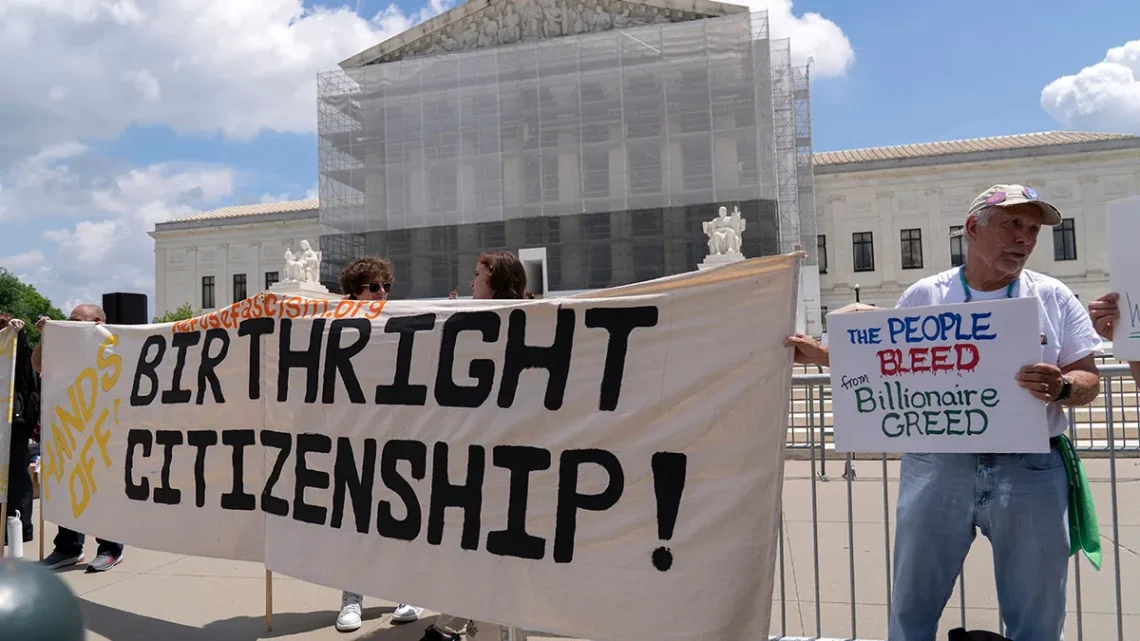
Birthright citizenship survived its biggest legal test in over a century today. On June 30, 2026, the U.S. Supreme Court struck down President Donald Trump’s executive order seeking to end automatic citizenship for children born on American soil, delivering one of the most consequential rulings of the term.

A Decade-Long Fight Reaches the Bench
Trump’s crusade against birthright citizenship didn’t start in the Oval Office. Trump first called for ending the practice back in August 2015, during his initial run for the Republican presidential nomination, branding it the “biggest magnet for illegal immigration.” A decade later, just hours after being sworn in for his second term, he made good on that promise. Forbes
The executive order specified that 30 days after taking effect, babies born in the U.S. would not be entitled to citizenship documents if their parents were undocumented or had immigrated illegally. Officially titled “Protecting the Meaning and Value of American Citizenship,” Executive Order 14160 declared that children born to parents who are unlawfully or only temporarily present in the country are not “subject to the jurisdiction” of the United States — and therefore not eligible for citizenship under the 14th Amendment. CNBCSupreme Court of the United States
That argument ran headlong into one of the most settled doctrines in American constitutional law.
From District Courts to the Supreme Court — An Unusual Path
The order never actually took effect anywhere. Multiple federal district judges ruled the order unconstitutional, and two appellate circuits upheld injunctions blocking it. Along the way, a strange procedural detour occurred: in June 2025, the Supreme Court ruled on a related but narrower question — whether individual judges could issue nationwide injunctions at all — without touching the legality of the birthright citizenship order itself. CNBC
It was only this year, in Trump v. Barbara, that the substantive question finally reached the justices. During April arguments, both conservative and liberal justices reportedly questioned the order’s legality, in a case made even more dramatic by Trump’s attendance in the courtroom — making him the first sitting president known to attend Supreme Court oral arguments. The plaintiffs were brought together by a remarkable coalition — the ACLU and its New Hampshire, Maine, and Massachusetts chapters, the Legal Defense Fund, the Asian Law Caucus, and the Democracy Defenders Fund — representing children who would have lost citizenship under the order. PBSNAACP Legal Defense Fund
A quietly powerful episode: the ACLU’s lead attorney on the case, Cecillia Wang, has a personal connection to the issue. Wang is herself a birthright citizen born to Chinese parents, and she argued before the Supreme Court in April that the framers of the 14th Amendment deliberately granted automatic citizenship to the child rather than the parent — so that “in America we do not punish children for the sins of their fathers.” NPR

How the Court Ruled — A 6-3 Rebuke
The numbers tell the story clearly. In a 6-3 ruling, the Court rebuked one of Trump’s most ambitious efforts to overhaul U.S. immigration practice, with the majority grounding birthright citizenship in both the Constitution and longstanding common-law tradition rather than accepting the administration’s narrower reading. Al Jazeera
Chief Justice John Roberts wrote for the majority. His opinion drew on colonial-era demands for the “rights of Englishmen” as well as abolitionist arguments for the “ancient and universal” rule of citizenship by birth, framing citizenship itself as “the right to have rights.” The opinion specifically held that children born in the U.S. to parents who are unlawfully or temporarily present are “subject to the jurisdiction” of the United States and are citizens at birth under the 14th Amendment’s Citizenship Clause. NPRSupreme Court of the United States
The coalition that joined Roberts was notable. Only one of the Court’s conservatives — Justice Amy Coney Barrett — sided with Roberts, alongside the three liberal justices, while three conservative members dissented from the decision. Justice Ketanji Brown Jackson filed a concurring opinion that Justice Sonia Sotomayor partly joined, and Justice Brett Kavanaugh wrote separately, concurring in the judgment while dissenting in part — a nuance that would matter enormously for what came next. CNN
On the dissenting side, the language was sharp. Justice Samuel Alito wrote that “the Court has made a serious mistake,” one of three separate dissents filed by the conservative justices. Justice Clarence Thomas, joined by Justice Neil Gorsuch, also dissented, with Thomas reportedly arguing the ruling “devalues” American citizenship. CNBC
A Surprising Historical Footnote
One of the more fascinating threads to come out of legal commentary today involves an episode from the darkest period of 20th-century American history. During World War II, when Japanese nationals were held as “enemy aliens” in U.S. internment camps, their newborn children were automatically granted American citizenship simply because they were born on U.S. soil — and Congress later codified that understanding into law. Legal scholars cited this episode repeatedly throughout the case as proof that birthright citizenship held firm even during the country’s most xenophobic chapters, rooted in the landmark 1898 case United States v. Wong Kim Ark, which the Court reaffirmed today. NPR
Trump’s Reaction — Defiant, Then Pivoting to Congress
The president did not take the loss quietly. On Truth Social, Trump wrote that the Supreme Court upholding birthright citizenship was “too bad for our Country,” but insisted “we can easily make it up in Congress through Legislation, with the support of the President” and that “no long and unwieldy Constitutional Amendment is necessary.” He called on Congress to begin working “TODAY” to end what he called an “expensive and unfair” policy, pledging his “Complete and Total Support.” The MirrorThe Mirror
In a separate, more biting post, Trump appeared to sarcastically congratulate Chinese President Xi Jinping “and the Great Country of China, on their massive Birthright Citizenship WIN!” — a reference to his long-running claim that wealthy foreign nationals exploit U.S. birth tourism. The Hill
White House Deputy Chief of Staff Stephen Miller, the architect of much of the administration’s immigration agenda, was similarly defiant. Miller wrote on X that “American citizenship is not the birthright of the world,” insisting it “belongs only and solely to Americans” and that no reading of the Constitution could require what he called the nation’s “self-obliteration.” Al Jazeera
Can Congress Actually Fix This? Republicans Are Split
This is where the ruling gets legally interesting — and where Trump’s claim that a simple law could undo the decision runs into trouble. Legal commentators noted that one of Trump’s own former allies on the case, John Eastman, doubted Congress could resolve the issue through ordinary legislation, a point Justice Kavanaugh also raised in his separate opinion and that House Speaker Mike Johnson echoed to reporters. As Eastman put it, since five justices found a constitutional mandate, Congress likely cannot simply legislate around it — barring a future case or a petition for rehearing. CNNCNN
Still, some Republicans see a narrow opening. Senator Eric Schmitt pointed to Kavanaugh’s opinion, which argued that while the order didn’t survive on 14th Amendment grounds, it may have separately violated the Immigration and Nationality Act — suggesting Congress could amend that statute instead, with Schmitt saying he is “filing legislation to walk through it.” Senator Lindsey Graham, a close Trump ally, similarly pledged to make restricting birthright citizenship a top priority in the Senate Judiciary Committee, framing it as a “major pull factor for birth tourism and illegal immigration.” Al JazeeraAl Jazeera
What Advocates Expect Next
Immigration rights groups largely see today’s ruling as the final word — for now. Cody Wofsy, deputy director of the ACLU’s immigrants’ rights project, said the organization doesn’t “anticipate that there will be a round two of this fight over birthright citizenship,” calling the rejection emphatic. But others are bracing for retaliation in other forms. Juan Proaño, CEO of the League of United Latin American Citizens, said he expects “this president will basically try and retaliate in some form or another.” Taryn Wilgus Null of the Democracy Defenders Fund echoed that sentiment, saying she “would be in no way surprised if the Trump administration re-ups their efforts to remove immigrants.” NBC News + 2
The practical stakes were enormous. According to estimates from the Migration Policy Institute and Penn State’s Population Research Institute, roughly 255,000 children per year would have been denied citizenship had Trump’s order taken effect. And the order’s reach extended further than many assumed. While Trump’s rhetoric centered on illegal immigration, the restrictions would also have applied to children of people legally present in the U.S. on a temporary basis, including students and green card applicants. ForbesPBS
The Bigger Picture: A Costly Term for Trump at the Court
Today’s ruling wasn’t an isolated defeat. It followed a separate Supreme Court decision earlier this year that struck down the global tariffs Trump had imposed under emergency powers legislation never before used in that way — a ruling Trump reacted to furiously at the time, saying he was “ashamed” of the justices. Tuesday’s session also included other major rulings: the Court allowed states to ban transgender athletes from girls’ sports teams, and it struck down Watergate-era limits on coordinated spending between political parties and candidates. The MirrorCNN
Key Takeaways
- The Supreme Court ruled 6-3 in Trump v. Barbara, striking down Executive Order 14160 and reaffirming that the 14th Amendment guarantees citizenship to nearly all children born on U.S. soil.
- Chief Justice Roberts wrote the majority opinion, joined by Justice Barrett and the Court’s three liberal justices.
- Trump is pivoting to Congress, but legal experts — including Justice Kavanaugh — suggest a constitutional amendment or new case may be needed, not ordinary legislation.
- Republicans like Senators Graham and Schmitt are already planning legislative pushes, eyeing a narrower opening tied to immigration statutes rather than the Constitution itself.
- Advocacy groups call the ruling decisive, though some expect the administration to shift its immigration crackdown elsewhere.
Sources:
- NPR — Supreme Court upholds birthright citizenship on constitutional grounds
- CNN — Supreme Court upholds birthright citizenship
- Washington Post — Supreme Court upholds birthright citizenship, ruling against Trump’s order
- PBS NewsHour — Supreme Court rejects Trump limits on birthright citizenship
- NBC News — Highlights: Supreme Court rules on Trump’s birthright citizenship order
- The Hill — Donald Trump calls on Congress to act after Supreme Court ruling
- Al Jazeera — Birthright citizenship ruling: US officials, lawmakers and advocates react
- NAACP Legal Defense Fund — Know Your Rights FAQ
- Supreme Court of the United States — Opinion, No. 25-365, Trump v. Barbara
- Forbes — Trump Promised Birthright Citizenship Would End
- The Mirror — Furious Trump vows to end birthright citizenship