The AI Stock Decline that unfolded in early 2026 has sent ripples through markets, with software, semiconductor, and Big Tech shares shedding trillions in value amid investor unease. This correction follows the explosive gains of 2024-2025, driven by generative AI hype, but recent events have exposed vulnerabilities in the AI investment thesis. Far from a collapse, the AI Stock Decline reflects a healthy repricing after years of exuberance, grounded in verifiable market dynamics, earnings reports, and analyst assessments.
The Backdrop to the AI Stock Decline
AI stocks surged post-ChatGPT’s 2022 launch, with Nvidia alone delivering massive returns as demand for GPUs exploded. By 2025, AI-related capex from hyperscalers like Microsoft, Google, Amazon, Meta, and Oracle fueled S&P 500 gains, accounting for the bulk of earnings and capital spending growth. However, the AI Stock Decline accelerated in late 2025 and intensified into 2026, erasing about $1 trillion from U.S. software and services firms in one week alone.
:max_bytes(150000):strip_icc()/MSTR_2025-12-15_14-25-54-205853e40b46499faaf5357ae9100bda.png)
(AI stocks decline chart from December 2025, illustrating the sharp pullback in Nasdaq and related names amid broader market volatility.)
Key stocks like Oracle plunged over 30% in Q4 2025, Nvidia faced intermittent drops, Salesforce lagged despite revenue growth, and software giants including ServiceNow and Salesforce suffered amid disruption fears.
Triggers Sparking the Recent AI Stock Decline
Several catalysts converged to ignite the AI Stock Decline:
- AI Disruption Fears in Software: Anthropic’s Claude AI advancements, including legal and marketing tools, sparked panic that AI agents could replace specialized SaaS subscriptions. This “software-mageddon” wiped out $1 trillion in market cap for software firms.
- Capex ROI Skepticism: Big Tech’s massive AI infrastructure spending—projected at $1.1 trillion for mega-caps through 2029—raised alarms over weak immediate returns. Microsoft, Amazon, Alphabet, and Meta faced scrutiny as debt-funded data center builds outpaced monetization.
- Valuation and Bubble Concerns: Surveys indicated 52% of respondents expected U.S. AI stocks to lose value in 2026, citing FOMO-driven bubbles akin to gold and tech parallels. High forward multiples and overinvestment warnings from Goldman Sachs CEO David Solomon, Jeff Bezos, and OpenAI’s Sam Altman amplified the selloff.
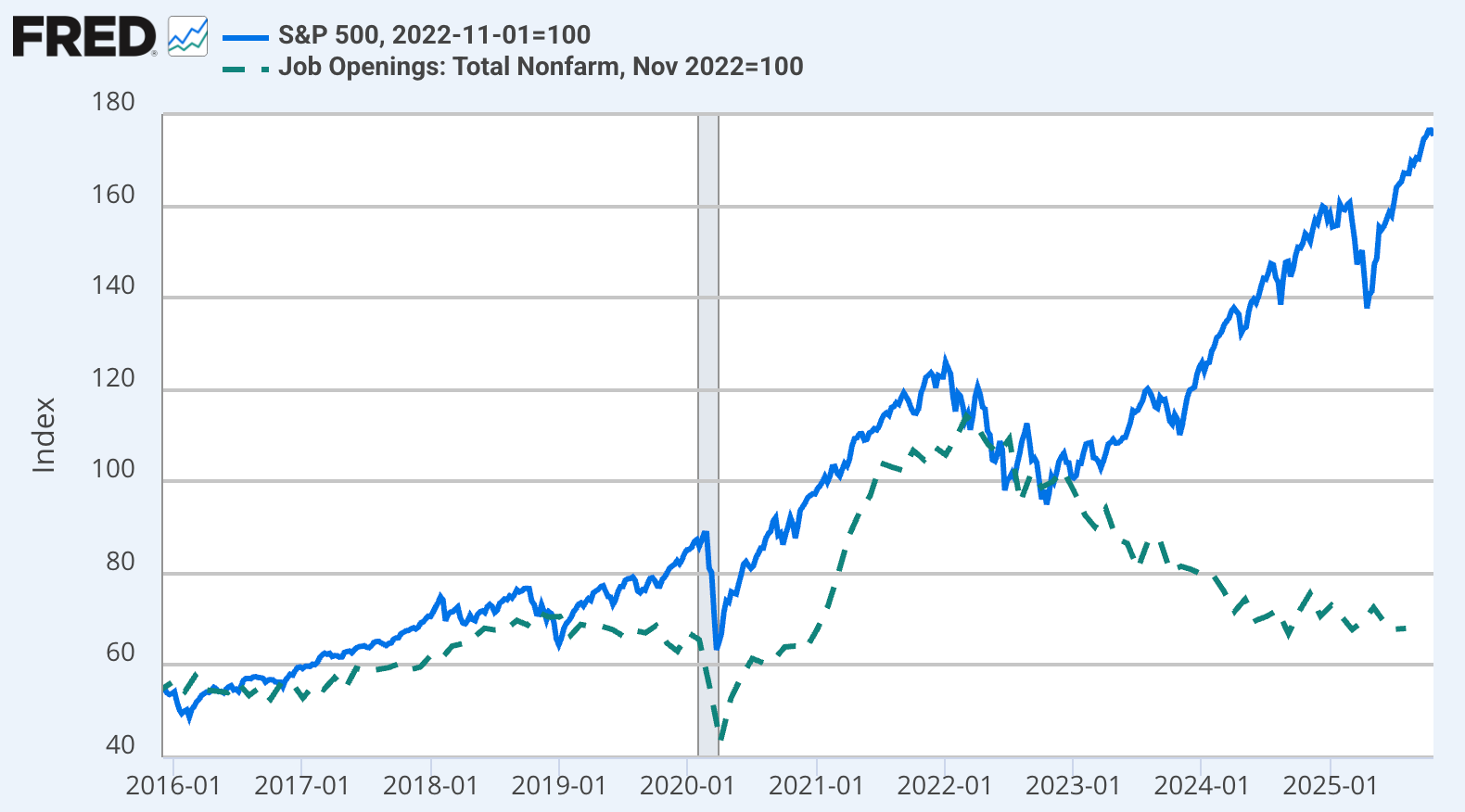
(Chart highlighting AI-related market dynamics, showing S&P 500 growth diverging from job openings post-ChatGPT, underscoring productivity vs. hype debates.)
Deeper Reasons Fueling the AI Stock Decline
At its core, the AI Stock Decline stems from mismatched timelines: infrastructure spending precedes revenue. Only a small fraction of organizations reported meaningful GenAI ROI by late 2025, with pilots rarely scaling. Competition intensified—Google’s Gemini threatened OpenAI, while Chinese models like DeepSeek triggered a January 2025 shock, dropping Nvidia shares 17% in one day.
Debt financing added risk: Hyperscalers ramped up borrowing 300% above norms to fund $3 trillion in projected AI capex through 2028. Earnings calls highlighted supply constraints (e.g., Azure) and competitive pressures, leading to downgrades like Stifel’s on Microsoft.

(S&P 500 Software and Services Index chart showing the decisive break below the 200-day moving average in early 2026, signaling oversold conditions during the AI Stock Decline.)
Entertaining Episodes That Defined the AI Stock Decline
The AI Stock Decline produced memorable moments:
- Jensen Huang’s “Illogical” Defense: Nvidia CEO Jensen Huang dismissed software replacement fears as “the most illogical thing in the world,” calling software a tool AI uses, not replaces. He spotlighted resilient names like ServiceNow and SAP during a Cisco event, helping stabilize sentiment.

(Nvidia CEO Jensen Huang speaking at a tech prosperity event, embodying the optimistic counter-narrative amid the AI Stock Decline.)
- DeepSeek Shockwave: The 2025 launch of China’s DeepSeek chatbot caused a classic bubble scare, with Nvidia tumbling 17% intraday before rebounding—echoing prior overreactions.
- Palantir and SaaS Drama: CEO Alex Karp’s earnings call warning that AI could obsolete SaaS models triggered a $300 billion wipeout, yet Bank of America called the panic “internally inconsistent” and overblown, akin to 2025’s DeepSeek selloff.
- OpenAI-Nvidia Tensions: Reports of OpenAI frustrations with Nvidia chip performance, coupled with Huang clarifying a $100 billion investment as an “invitation,” added intrigue to the hype-vs-reality saga.

Future Outlook Amid the AI Stock Decline
Despite the AI Stock Decline, the long-term trajectory remains robust. Analysts view the selloff as overblown, driven by fear rather than fundamentals. AI adoption is broadening beyond hyperscalers into sectors like healthcare, logistics, and finance, with productivity gains expected to drive 13-15% above-trend earnings growth.
Capex is forecasted to surge—$5-8 trillion through 2030—with hyperscale spending up 38% in 2026 alone. Risks like overcapacity or debt persist, but consensus points to a “supercycle” where AI becomes pervasive, not peripheral.

(Illustrative image of AI technology growth, showing hands cradling a globe with AI icons, symbolizing the expansive future beyond the current AI Stock Decline.)

(Futuristic AI automation scene with robotic hands interacting with digital interfaces, representing productivity gains that could sustain post-decline recovery.)
Valuations are adjusting toward fairer levels, creating entry points for investors. Bank of America and others expect volatility but affirm AI’s defining role, with potential for 4-7% normalized market returns tempered by tech leadership.
Wrapping Up the AI Stock Decline Story
The AI Stock Decline of 2026 serves as a corrective pause in an otherwise transformative era. By separating hype from fundamentals, markets are maturing—setting the stage for sustainable growth as AI delivers on its promise. Investors who navigate this with discipline stand to benefit from the broadening impact ahead.
Sources and Links (clickable for verification):
- CNBC on software selloff: https://www.cnbc.com/2026/02/04/software-experiencing-most-exciting-moment-as-ai-fears-hammer-stocks.html
- Reuters on software stocks: https://www.reuters.com/business/us-software-stocks-stabilize-after-bruising-selloff-ai-disruption-fears-2026-02-05/
- Wikipedia AI bubble: https://en.wikipedia.org/wiki/AI_bubble
- Fortune/BofA analysis: https://fortune.com/2026/02/04/why-saas-stocks-tech-selloff-freefall-like-deepseek-2025-overblown-paradox-irrational/
- Additional references from Morningstar, Vanguard, J.P. Morgan, and others as cited inline.