In the turbulent landscape of American history, the US Fractional Currency stands as a testament to ingenuity amid crisis. Particularly, the 50-Cent Note from the Civil War Era captures a unique chapter where paper money bridged the gap left by vanishing coins. This overlooked artifact, born from wartime necessities, reveals layers of economic innovation and cultural quirks that set it apart from modern currency tales.
Origins of US Fractional Currency: The Civil War Era Spark
The US Fractional Currency emerged during the Civil War Era, a period marked by severe coin shortages. As the Civil War erupted in 1861, public panic led to widespread hoarding of gold and silver coins. Banks suspended specie payments, meaning they stopped exchanging paper money for precious metals, causing the value of paper currency to plummet. By June 1862, one paper dollar was worth only about 91.69 cents in gold. This chaos disrupted everyday transactions, as small change became scarce.
To combat this, Treasurer Francis E. Spinner proposed an innovative solution: using postage stamps as makeshift currency. Congress acted swiftly, passing the Postage Currency Act on July 17, 1862, authorizing the issuance of fractional notes in denominations including 5, 10, 25, and 50 cents. These were the first iterations of US Fractional Currency, issued from August 21, 1862, to February 15, 1876, across five distinct periods. The 50-Cent Note, a key player in this system, helped merchants provide change without resorting to desperate measures like cutting dollar bills in half or issuing unauthorized local scrip.
Imagine the Civil War Era streets: shopkeepers refusing to give change without a premium, or people using Spanish quarter dollars as substitutes. The US Fractional Currency, especially the 50-Cent Note, stepped in as a lifeline, stabilizing commerce in a divided nation.
Evolution Through Five Issues: Designs and Features of the 50-Cent Note
The US Fractional Currency evolved over its lifespan, with the 50-Cent Note appearing in various designs that reflected the era’s artistic and security needs. The First Issue (1862-1863), known as Postage Currency, featured overlapping stamp imprints: the 50-Cent Note bore five 10-cent George Washington stamps, printed on Treasury paper to mimic actual postage. This design was Spinner’s brainchild, but counterfeiting soon plagued it, prompting redesigns.
By the Second Issue (1863), the US Fractional Currency shed its stamp-like appearance slightly, though the 50-Cent Note retained a bronze oval overlay for added security. The Third Issue introduced portraits; for instance, some 50-Cent Notes depicted Spinner himself, earning nicknames like “Spinner’s Fancy” due to elaborate back designs.
The Fourth Issue (1869-1875) included unique elements like the only 15-cent denomination, but the 50-Cent Note often featured Edwin M. Stanton or Abraham Lincoln, adding historical gravitas. Finally, the Fifth Issue (1874-1876) showcased William H. Crawford on the 50-Cent Note, with red seals and fiber-embedded paper to deter fakes. These notes were smaller than full dollars, lacking serial numbers initially, and measured about 3.5 by 2 inches.
Throughout the Civil War Era and beyond, the 50-Cent Note’s designs incorporated anti-counterfeiting measures like intricate borders and colored inks, making US Fractional Currency a pioneer in secure printing.
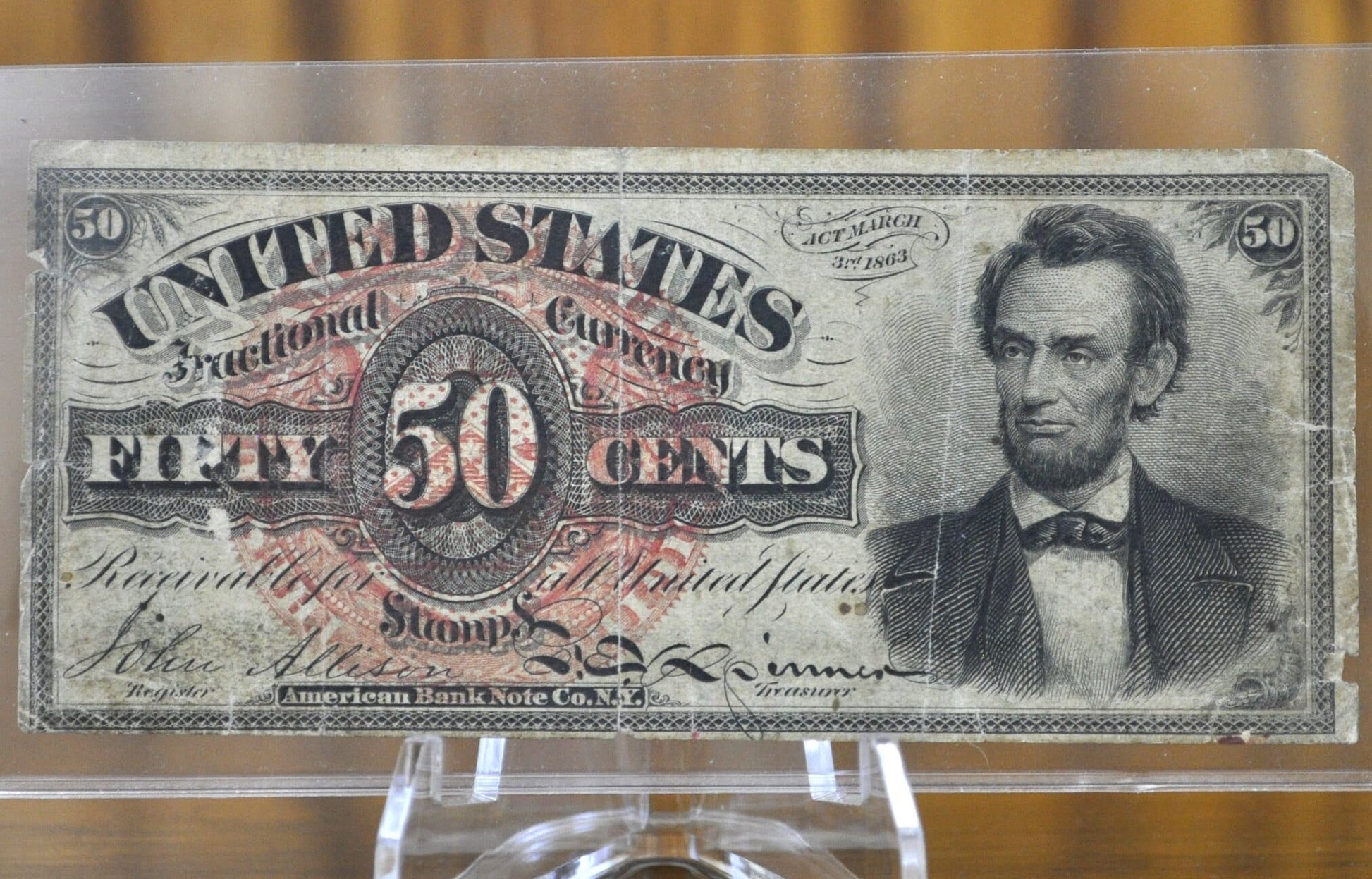
(Image Description: A Fourth Issue 50-Cent Note portraying Abraham Lincoln, highlighting the somber portrait and red overprint characteristic of mid-Civil War Era US Fractional Currency adaptations.)
Intriguing Episodes: Shinplasters and Wartime Whims in the Civil War Era
The US Fractional Currency, particularly the 50-Cent Note, spawned fascinating tales that humanize this Civil War Era innovation. Nicknamed “shinplasters” – a term from Revolutionary War soldiers who used paper money to pad their boots against blisters – these notes evoked mixed feelings. One amusing episode involves Spinner’s initial prototype: he glued stamps to paper and signed them personally, leading to the first official issues. Legend has it that Spinner’s daughters helped assemble early versions, turning a treasury office into a family craft session.
Counterfeiting added drama; forgers exploited the 50-Cent Note’s stamp designs, prompting rapid iterations. In one notorious case, a Philadelphia ring produced fakes so convincing that they circulated widely before detection. Another quirky story: during the war, soldiers traded these notes for goods, but inflation made them nearly worthless in the South, contrasting their utility in the North.
Post-war, the 50-Cent Note featured in redemption drives; by 1876, fractional silver coins replaced them, but many hoarded the paper versions as mementos. A collector’s anecdote from the 1870s describes a New York banker discovering a stash of unused Civil War Era US Fractional Currency in an old safe, sparking a numismatic frenzy. These episodes underscore how the 50-Cent Note wasn’t just money – it was a cultural artifact woven into America’s resilient spirit.
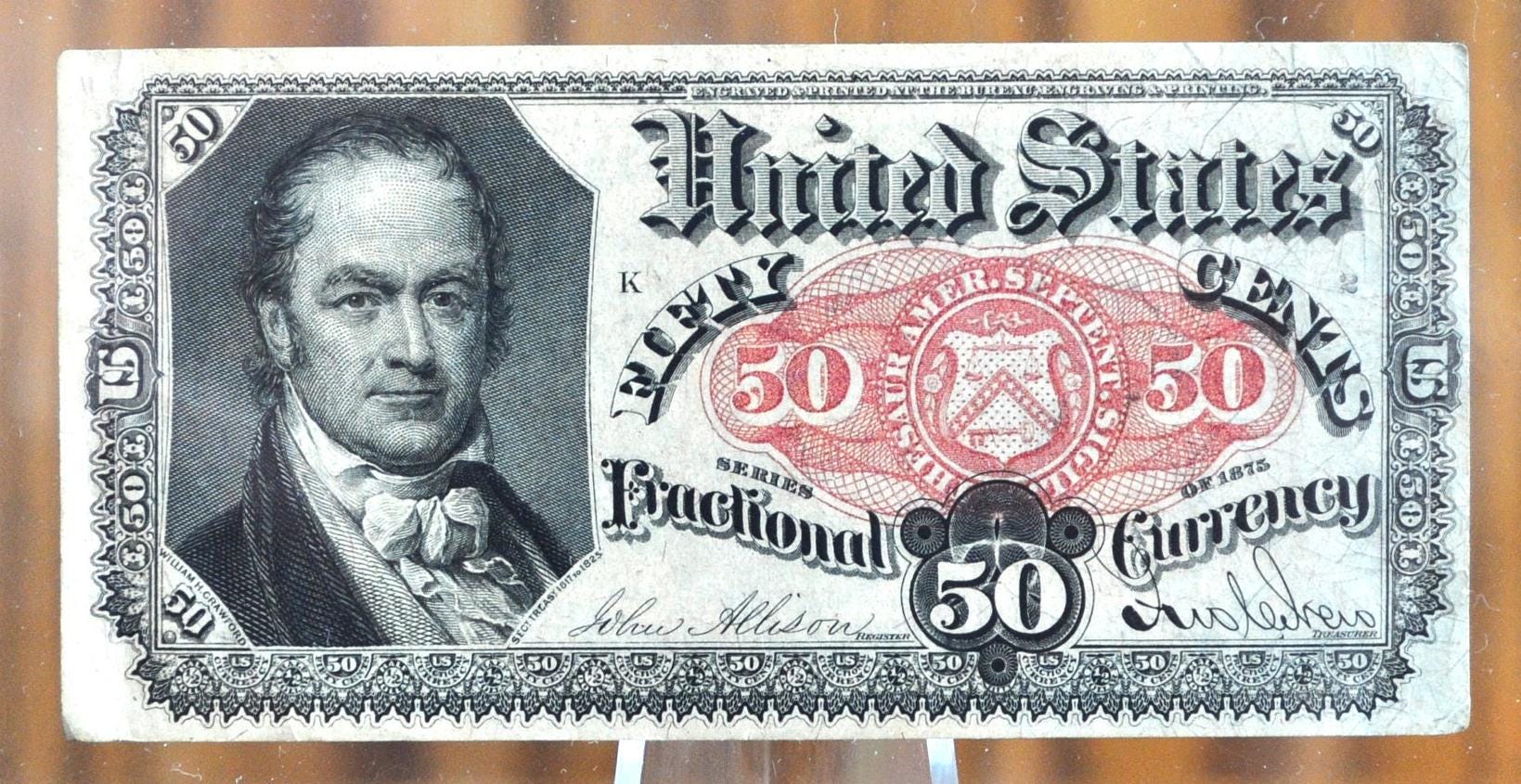
(Image Description: Close-up of a Fifth Issue 50-Cent Note with detailed engravings of William H. Crawford, illustrating the sophisticated artistry in US Fractional Currency from the late Civil War Era.)
Collecting the 50-Cent Note Today: Rarity and Legacy in US Fractional Currency
In modern times, the 50-Cent Note from the Civil War Era remains a sought-after relic among numismatists. Values vary: circulated examples fetch $50-$200, while uncirculated ones can exceed $1,000, depending on issue and condition. The US Fractional Currency’s legacy lies in its role as a bridge to today’s coinage system; it paved the way for the Specie Payment Resumption Act of 1875, which restored metal-backed currency.
What sets the 50-Cent Note apart is its scarcity in higher grades – many were worn out from heavy use. Collectors prize varieties like the “autographed” Spinner notes or those with printing errors, adding layers of intrigue. This Civil War Era piece reminds us how economic desperation birthed creative solutions, influencing U.S. monetary policy for generations.
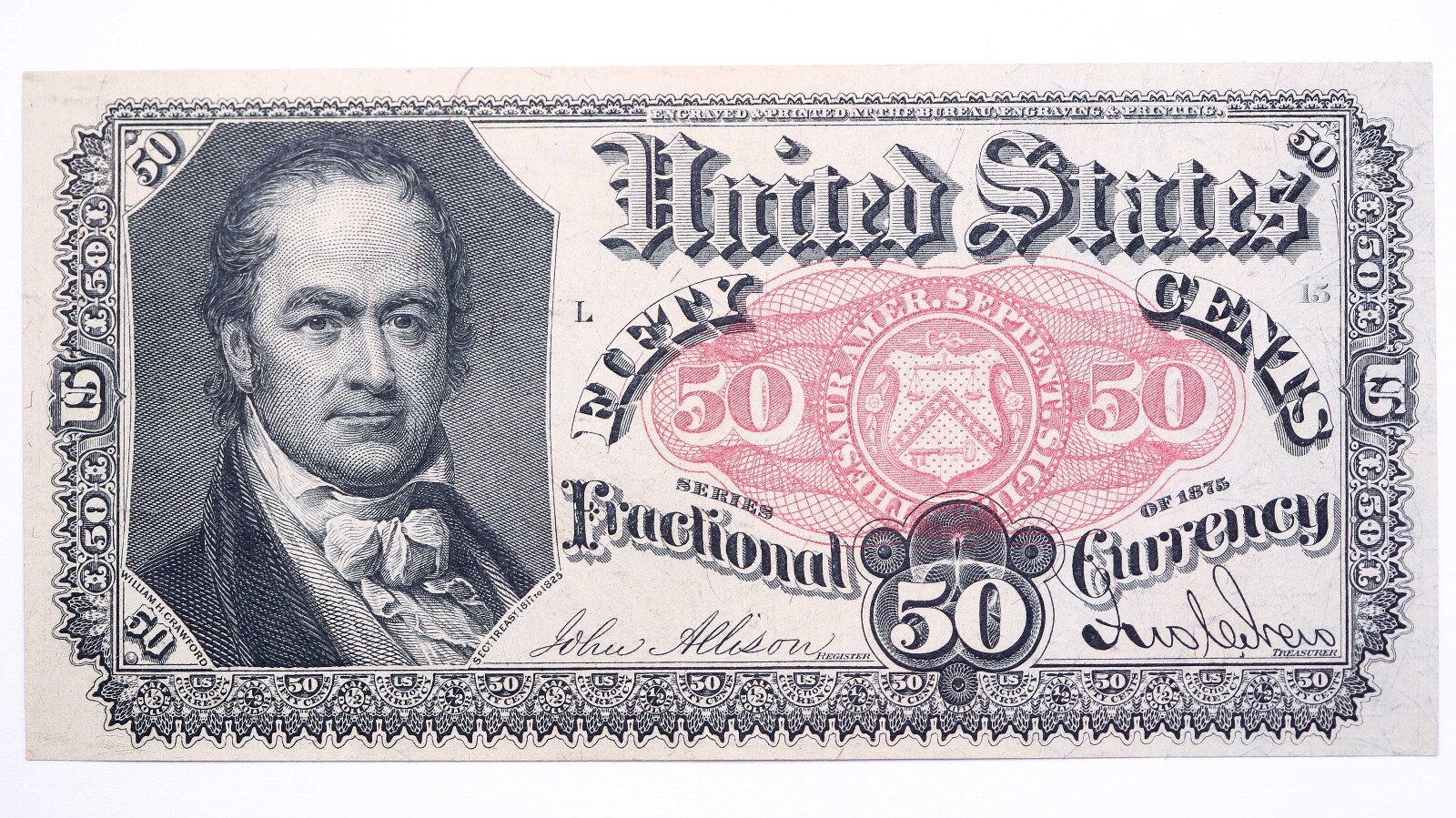
(Image Description: A pristine 1875 50-Cent Note with William H. Crawford’s portrait and red seal, exemplifying the peak of design in US Fractional Currency during the post-Civil War Era reconstruction.)
The Enduring Impact: Why the Civil War Era 50-Cent Note Matters
The US Fractional Currency, epitomized by the 50-Cent Note, encapsulates a pivotal Civil War Era moment when paper filled the void of metal. Beyond utility, it sparked innovations in printing and anti-forgery tech, influencing modern bills. As we reflect on this, the 50-Cent Note stands as a subtle hero – small in size, immense in historical weight.
WILLIAM CRAWFORD 1875 FIFTH ISSUE 50 CENT US FRACTIONAL CURRENCY NOTE
Sources and Links
For deeper dives, explore these verified resources:
- Wikipedia on Fractional Currency: https://en.wikipedia.org/wiki/Fractional_currency
- Smithsonian National Museum of American History: https://americanhistory.si.edu/collections/nmah_1839353
- Coin World Article: https://www.coinworld.com/news/paper-money/there-was-a-time-when-50-cent-fractional-notes-circulated.html
- Metropolitan Museum of Art: https://www.metmuseum.org/art/collection/search/732505
- BEP History Fact Sheet: https://www.bep.gov/media/1076/download?inline=