In the chaos of the American Civil War, when coins vanished from circulation, the U.S. government turned to an unlikely solution: tiny paper notes worth just 25 cents. The 25-Cent Fractional Currency became a makeshift “paper quarter” that kept everyday trade alive when metal money was hoarded for its bullion value. Far from ordinary bills, these fragile slips of history are packed with ingenuity, anti-counterfeiting tricks, and even a dash of controversy.
Why the 25-Cent Fractional Currency Was Born
The Civil War triggered a nationwide coin shortage starting in late 1861. Gold and silver coins were worth more melted down than their face value amid rising premiums, so people hoarded them. Banks suspended specie payments, and small change dried up—leading to barter, cut-up dollar bills, or privately printed “shinplasters.”

caseantiques.com (Lot 7: Pair Of 25 Cent U.S. Fractional Banknotes | Case Auctions)
Treasury officials, led by the ingenious Francis E. Spinner, improvised. Spinner literally pasted postage stamps onto Treasury paper and signed them by hand—creating the first “postage currency.” Congress formalized this with the Postage Currency Bill in July 1862, signed by Lincoln. The 25-Cent Fractional Currency debuted in the First Issue (August 1862–May 1863) as a bridge between stamps and proper notes.
Over five issues (1862–1876), the 25-Cent Fractional Currency evolved dramatically to fight counterfeiting, incorporating bronze ovals, surcharges, silk fibers, watermarks, and tinted paper. Production ended in February 1876 as silver coinage resumed post-war.
Designs That Told a Story: Evolution of the 25-Cent Fractional Currency
Each issue brought fresh looks and security upgrades:
- First Issue (Postage Currency): Mimicked five 5-cent Jefferson stamps arranged in a row. Brown ink, perforated or straight edges, and simple text. These were literal “stamp money” transitions.
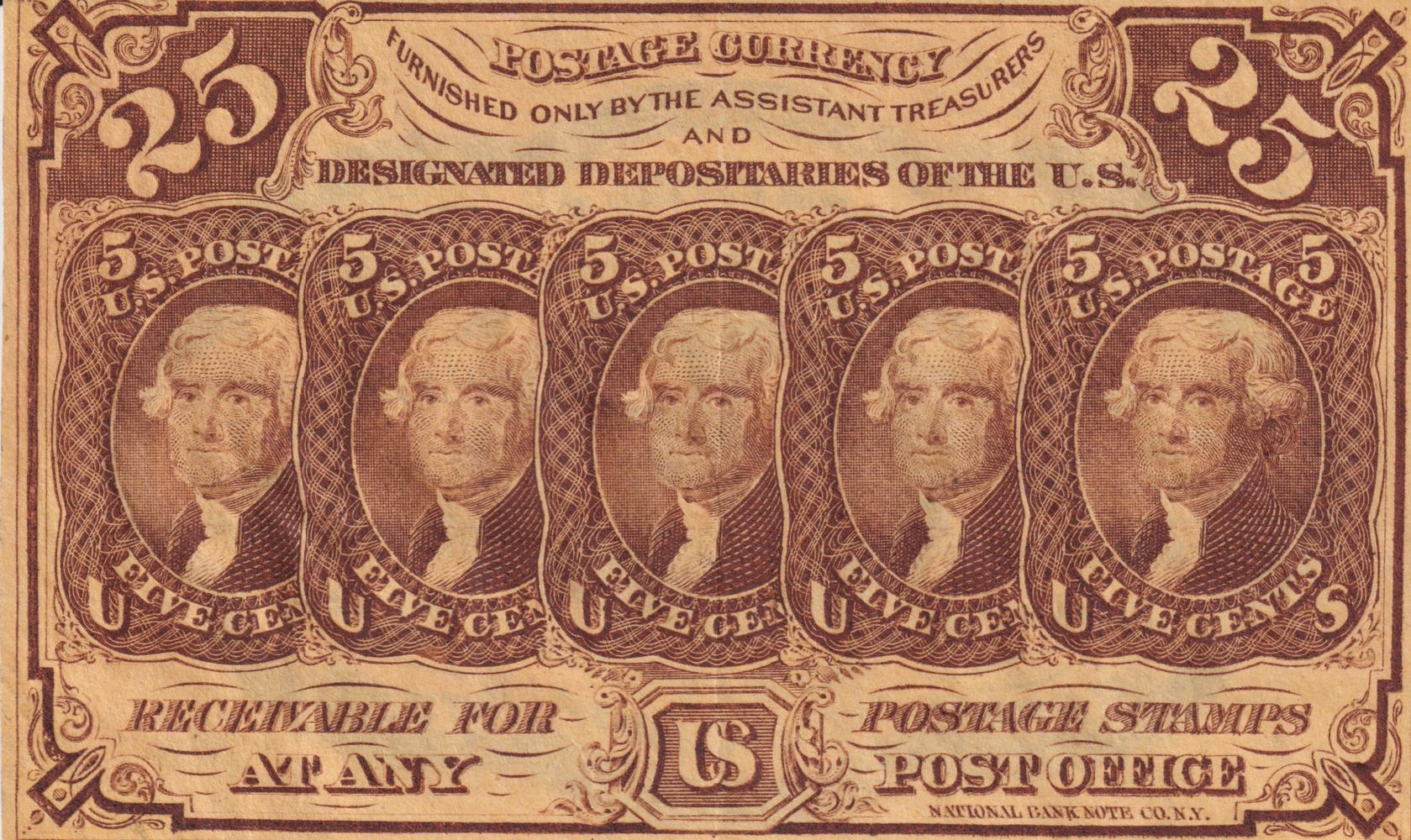
Fractional/Postage
- Second Issue (1863–1867): Added a bronze oval around George Washington to block photo counterfeiting, plus reverse surcharges (like “18-63”) and fiber paper.
- Third Issue (1864–1869): Featured Treasury Secretary William P. Fessenden—sparking debate because he was alive. Red/green reverses and surcharges helped deter fakes.
- Fourth Issue (1869–1875): Returned to George Washington, with watermarked “US” paper, silk fibers, and blue-tinted edges for extra security.
- Fifth Issue (1874–1876): Showcased Robert J. Walker (Treasury Secretary 1845–1849), with color tints, silk fibers, and Treasury seal variations (short thick key vs. long thin key). This was the final version of the 25-Cent Fractional Currency.
The 1866 law banning living persons’ portraits on currency (prompted by the Fessenden portrait controversy) shaped later designs.
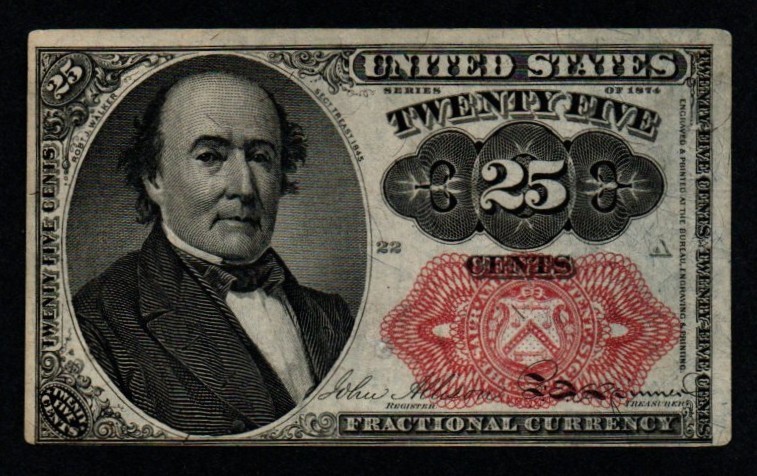
ebay.com (5th Issue 25c Robert Walker BEAUTIFUL AU+ Fractional Currency!)
Fun Episodes and the “Shinplaster” Nickname
These notes earned the derogatory nickname “shinplasters”—thin, flimsy paper likened to cheap bandages or shoe liners. Though the term stuck more firmly to Canadian 25-cent notes, U.S. versions were mocked similarly for their fragility and low value.
One quirky tale: Early notes were so thin that people reportedly used them as makeshift bandages or cigarette papers. Counterfeiters struggled with the evolving designs—bronze ovals thwarted photography, surcharges confused duplicates, and fibers made forgery detectable.
Another twist: The 25-Cent Fractional Currency wasn’t legal tender but was receivable for U.S. dues up to $5 and exchangeable in $5 lots for larger notes—making it a practical workaround in wartime chaos.
Legacy of the 25-Cent Fractional Currency
By 1876, the coin crisis eased, and fractional paper faded into numismatic history. Today, these notes are prized by collectors for their ingenuity and Civil War connection—often graded by PMG or PCGS and fetching hundreds in high grades.
The 25-Cent Fractional Currency reminds us how crisis sparks creativity: from pasted stamps to sophisticated anti-counterfeit tech, it was America’s paper lifeline when quarters disappeared.