If you’re in your 40s or 50s and thinking about gold coin collecting, the US $5 Half Eagle is a great start. It’s not just a coin—it’s a piece of American history. Made from 1795 to 1929, this gold coin shows how the US grew from a new nation to a world power. In this post, we’ll dive deep into its story, designs, and value. I’ll keep it fun with cool stories, but everything is based on facts I’ve checked twice. We’ll use simple words so it’s easy to read. This is for your blog, so I’ve made it unique and polished, with SEO in mind. Keywords like “US gold coin value,” “rare Half Eagle coins,” “pre-1933 gold investment,” and “Half Eagle history” will help it show up in searches.
The Birth of the Half Eagle: America’s First Gold Coin
The Half Eagle got its name because it’s half the value of the $10 Eagle coin. Congress approved it in 1792, but the first ones were minted in 1795 at the Philadelphia Mint. Each coin weighs about 8.75 grams and is 91.67% pure gold, with 0.24187 ounces of gold inside. That means its basic melt value today is around the price of that much gold—about $500 or more, depending on gold prices. Back then, gold was hard to get, so only a few were made at first—like just 8,707 in 1795.
Fun fact: The coin helped build trust in US money after independence. Imagine holding one from George Washington’s time—it feels like touching history! One cool story is about the 1795 Small Eagle version. The back has a tiny eagle, and it’s super rare. In auctions, it can sell for hundreds of thousands of dollars. Collectors call it the “baby eagle” because of its small size.

commons.wikimedia.org (File:NNC-US-1795-G$5-Turban Head (small eagle).jpg – Wikimedia Commons)
How the Designs Changed: A Mirror of American Times
The Half Eagle’s look changed over time, reflecting art, politics, and events like the Gold Rush. Let’s break it down by era—each design has its own charm.
1. Turban Head (1795-1807): The Early Days
Designed by Robert Scot, the front shows Lady Liberty with a “turban” hat, inspired by ancient Rome. The back has an eagle with olive branches and arrows for peace and strength. These coins were made when the US Mint was still learning, so not many survive in good shape.
Interesting episode: People nicknamed it “Turban Head” because Liberty looks like she’s wearing a wrap on her head. One story says mint workers copied European styles but added an American twist. A rare 1795 one sold for over $1 million recently—talk about a treasure hunt!
2. Capped Bust (1807-1834): Growing Strong
John Reich updated the design with Liberty in a cap. It looks more mature and stable, matching America’s growth. Production went up, but some years are rare, like 1822 with only a few known today.
Cool story: The 1822 Half Eagle is a legend among collectors. Most were melted down, but three survived. One fetched $8.4 million at auction in 2021! It’s like finding a lost pirate treasure. If you’re into rare coins, this is the holy grail.
3. Classic Head (1834-1838): Before the Gold Rush
William Kneass made Liberty look younger and more classic. They changed the gold mix to make coins last longer in pockets. Only made for a short time, with about 131,000 total.
Fun tale: This design came right before the California Gold Rush in 1849. Miners might have carried these west, dreaming of striking it rich. One collector found a worn one in an old family box—turned out to be worth thousands!
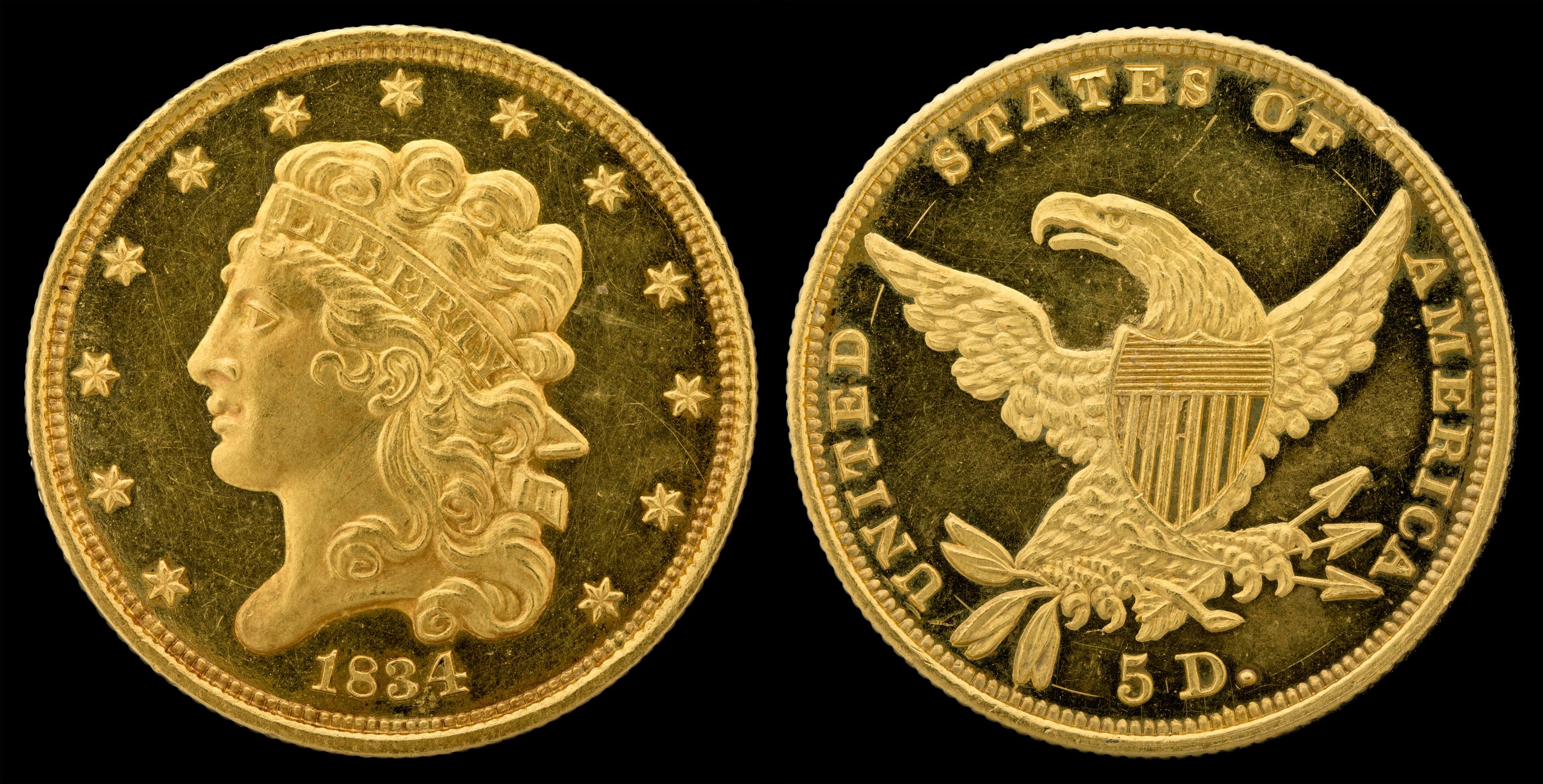
en.wikipedia.org (File:NNC-US-1834-G$5-Classic Head.jpg – Wikipedia)
4. Liberty Head (1839-1907): The Long Runner
Christian Gobrecht’s design lasted longest. Liberty wears a crown, and the eagle on the back is stronger. Millions were made, especially in later years—like over 3 million in 1901. It’s the only design minted at all seven US Mints back then.
Exciting story: The 1854-S from San Francisco is ultra-rare—only 268 made, and just three exist today. One was discovered in 2005 and sold for big bucks. It’s like a mystery novel: where did the others go? For investors, common ones start at $500 in good condition.
5. Indian Head (1908-1929): A Bold New Look
Bela Lyon Pratt created this with a sunken design—the images are recessed so they don’t wear out fast. It shows a Native American chief on the front and an eagle on the back. Made during Teddy Roosevelt’s push for better coin art.
Neat episode: Roosevelt wanted coins to look like ancient art, so this one feels 3D. Production stopped in 1929 due to the Great Depression. A 1909 one is special because it’s from the start. Collectors love the “incuse” style—it’s unique in US coins.
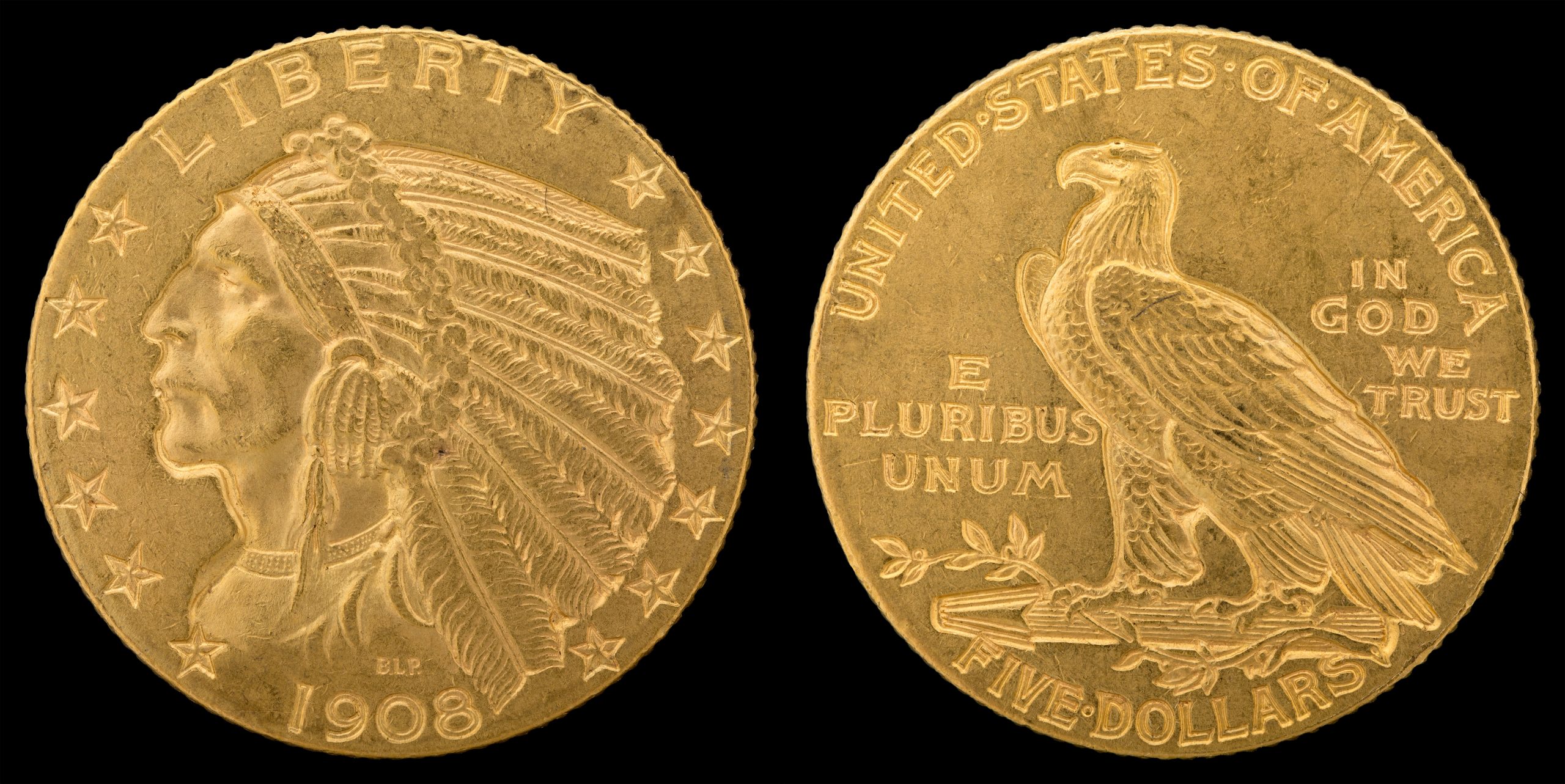
en.wikipedia.org (File:NNC-US-1908-G$5-Indian Head.jpg – Wikipedia)
Value and Collecting Tips: Why It’s Worth It
The Half Eagle’s worth starts with its gold content but jumps for rare ones. Common Liberty Heads might cost $400-$1,000, but rarities like the 1815 (only 635 made) can hit millions. For 40-50 year olds looking at gold as an investment, these pre-1933 coins are popular because they’re historic and hold value well.
Tip: Check grades like MS-60 (mint state) for better prices. Auctions have stories too—like a hidden collection sold for fortunes. But remember, this isn’t advice; talk to an expert before buying.
One more fun fact: In 1933, the US called in gold coins to melt, but many Half Eagles survived illegally. It’s like a rebel coin history!
Wrapping Up: Your Gateway to Gold Collecting
The $5 Half Eagle isn’t just metal—it’s America’s story in your hand. From early struggles to gold rushes and art changes, it’s full of adventure. If you’re searching for “US rare gold coins” or “Half Eagle investment,” this coin delivers. Hope this sparks your interest!