In the realm of American rare coins, the $4 Stella stands as a captivating artifact of ambition and intrigue, blending international diplomacy with numismatic artistry. Often searched by 40s and 50s enthusiasts under terms like “rare gold coin values,” “American pattern coins history,” “Stella coin auctions,” “numismatic scandals,” and “19th century trade coins,” this piece transcends mere currency—it’s a window into America’s global aspirations. This in-depth exploration draws solely from verified sources, weaving factual details with engaging episodes to offer a refined perspective unlike typical overviews. Whether you’re a seasoned collector eyeing investments or a history buff, discover why the Stella remains a pinnacle of coin collecting.
Origins of the $4 Stella: A Bold Experiment in Global Trade
Born in the late 1870s, the $4 Stella emerged from America’s desire to align with Europe’s Latin Monetary Union (LMU), a coalition standardizing gold and silver coins for seamless trade among nations like France and Austria-Hungary. U.S. diplomat John A. Kasson, serving as minister to Austria, championed the idea, proposing a coin that matched popular European denominations like the Austrian 8 florin or French 20 franc. Weighing exactly 7 grams (6 grams gold, 0.3 grams silver, 0.7 grams copper) with a 85.7% gold purity, it aimed to facilitate international commerce without conversion hassles.
Congress ultimately rejected the proposal, but not before patterns were minted in 1879 and 1880 at the Philadelphia Mint. Named “Stella” after the Latin word for “star,” reflecting its reverse design, this coin represented a fleeting dream of economic unity. Intriguingly, Kasson’s advocacy involved lobbying from figures like former Confederate Vice President Alexander H. Stephens, then a congressman, highlighting post-Civil War political reconciliations in unexpected ways.
A fun episode: Initial strikes were limited, but demand from congressmen led to “restrikes”—additional mintings sold at cost. This sparked whispers of favoritism, as coins reportedly ended up in the hands of influential insiders, underscoring the era’s blend of innovation and insider dealings.
Artistic Mastery: Flowing Hair vs. Coiled Hair Designs
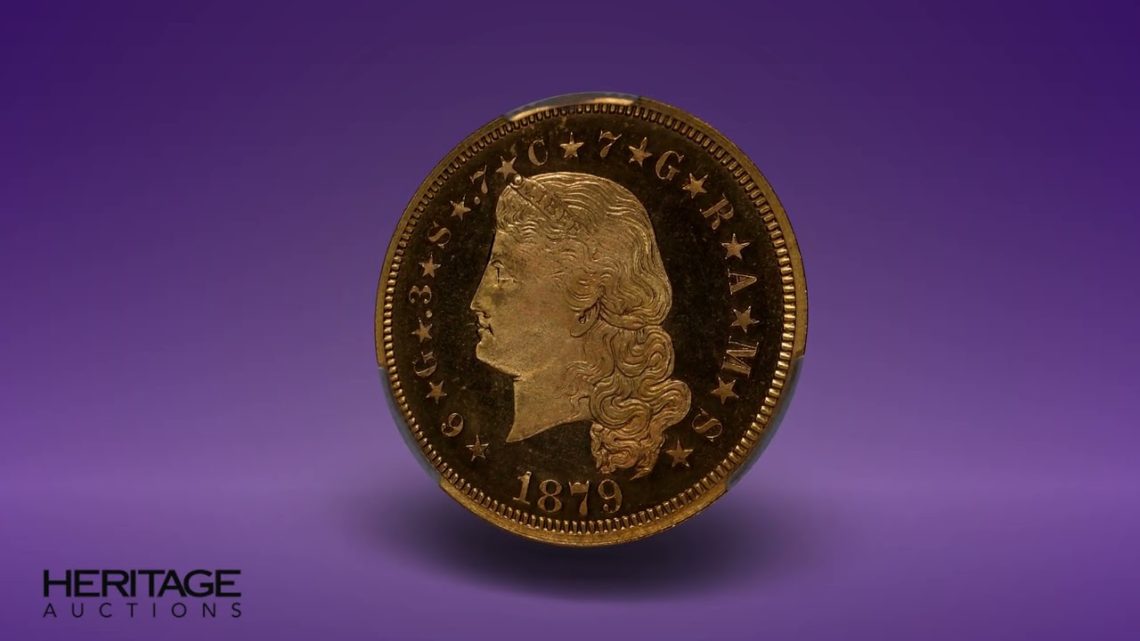
The Stella’s allure lies in its dual designs, each a masterpiece by renowned engravers. The 1879 “Flowing Hair” variant, crafted by Chief Engraver Charles E. Barber, features Liberty’s profile with unbound, windswept locks—a romantic nod to classical imagery. In contrast, the 1880 “Coiled Hair” by George T. Morgan (of Morgan Dollar fame) presents a more refined Liberty with hair elegantly coiled, evoking sophistication.
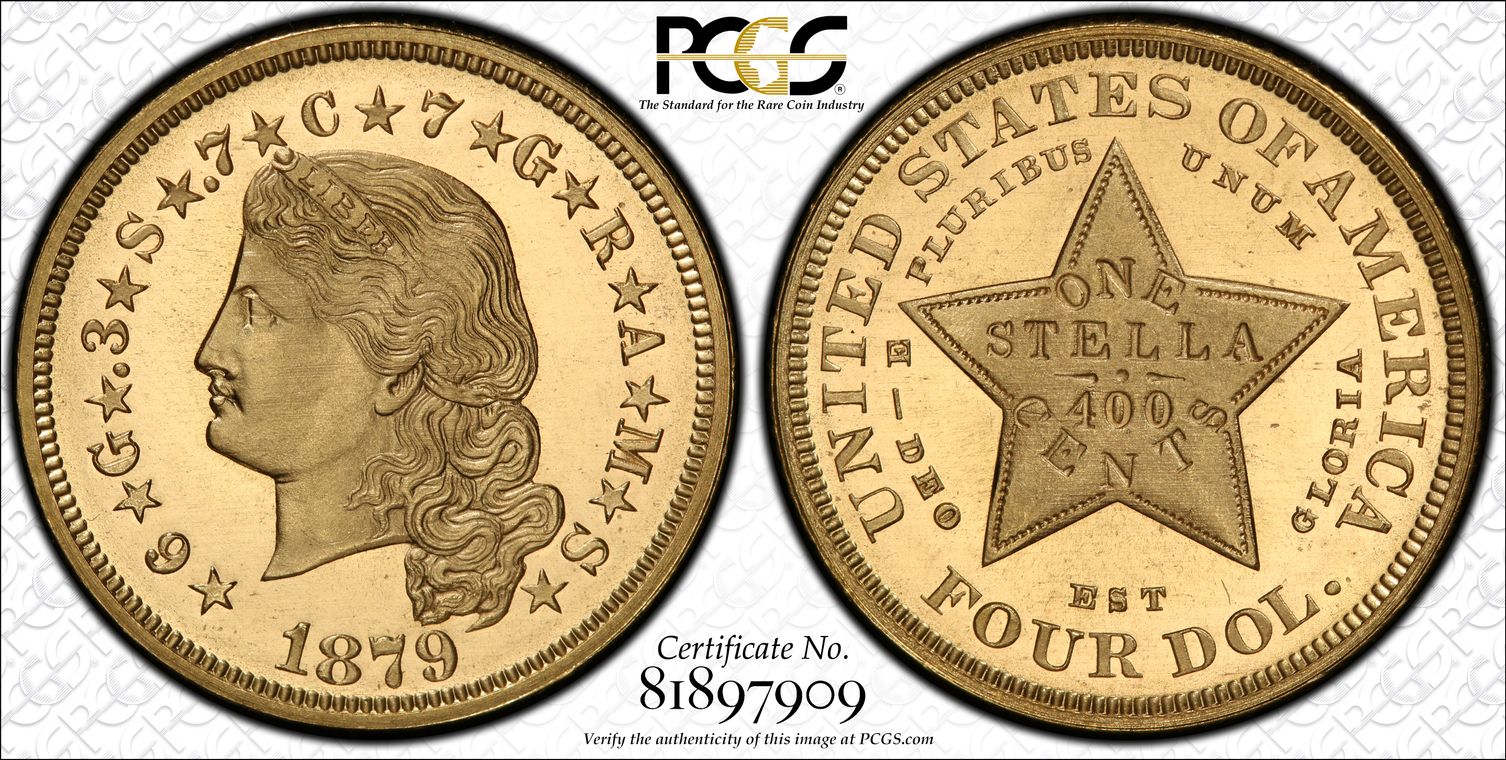
Obverse details include Liberty facing left, encircled by stars denoting the composition: ★6★G★.3★S★.7★C★7★G★R★A★M★S★. The reverse boasts a five-pointed star inscribed with “ONE STELLA” and “400 CENTS,” flanked by “E PLURIBUS UNUM” and “DEO EST GLORIA” (“Glory to God”). Measuring 22mm in diameter with a reeded edge, its goloid alloy gleams with a distinctive hue.
What sets the Stella apart in numismatics? Its metric-inspired specs deviated slightly from LMU standards, dooming it practically but elevating it artistically. Collectors prize the subtle variations, like the diadem on Liberty’s head, symbolizing enlightenment.

NNC-US-1879-G$4-Stella Pattern (Flowing Hair) – PICRYL – Public …
(Above: A high-resolution view of the 1879 Flowing Hair Stella, showcasing its intricate details—perfect for envisioning in your collection.)
Production Insights: Rarity Through Restrikes and Limited Mints
Minted solely as patterns, production was minuscule. The 1879 Flowing Hair started with just 15 originals, but restrikes pushed estimates to 425-700 pieces. The 1880 issues are scarcer: about 25 Flowing Hair and a mere 10-15 Coiled Hair survive.
These restrikes, often in proof quality, were distributed to congressmen for evaluation, fueling its elite status. No circulation strikes exist, making every Stella a collector’s gem.
A scandalous tale: Rumors swirled that some Stellas adorned necklaces of Washington D.C.’s madams, gifted by enamored politicians in exchange for “favors.” Dubbed the “coin of ill-repute,” this lore—though unproven—adds a layer of Victorian intrigue, as noted by numismatists like those at CoinWeek. Imagine: a diplomatic tool turned scandal prop!
Another quirky episode: In 1879, experimental “quintuple Stellas” ($20 patterns) were struck in tiny numbers, linking the Stella to broader mint innovations and fetching astronomical prices today.
World’s Finest $4 Stella Set at 2024 ANA Convention
(Above: The exquisite Coiled Hair variant, a testament to Morgan’s artistry and the coin’s enduring elegance.)
Market Value and Auction Legends: A Collector’s Holy Grail
Today, Stellas command premium prices in the numismatic market. A 1879 Flowing Hair in top condition (e.g., PCGS PR67CAM) can fetch $200,000+, while an 1880 Coiled Hair sold for $258,500 in recent auctions. The full set, including all variants, was showcased at the 2024 ANA World’s Fair of Money, drawing crowds and underscoring its status.
Values fluctuate based on grade, provenance, and rarity—Coiled Hair pieces often headline sales due to their scarcity. For 40s and 50s investors searching “gold coin auction records,” the Stella exemplifies high-return potential, though always consult experts for authenticity.
One legendary auction story: A 1880 Coiled Hair, once polished but still pristine, shattered expectations at $258,500, proving that even “imperfect” rarities hold immense appeal.
Reflections: Why the $4 Stella Endures in Numismatic Lore
Beyond its metal, the Stella encapsulates an era of innovation tempered by scandal and failure—yet it shines as a triumph for collectors. Its tales of diplomacy, design brilliance, and whispered improprieties offer a nuanced view, distinguishing this narrative from rote histories. For deeper dives, explore certified dealers or museums.

1879 $4 Flowing Hair, Judd-1635, Pollock-1833, JD-1, R.3, PR66 …
(Above: Another angle of the Flowing Hair Stella, highlighting its proof-like luster.)