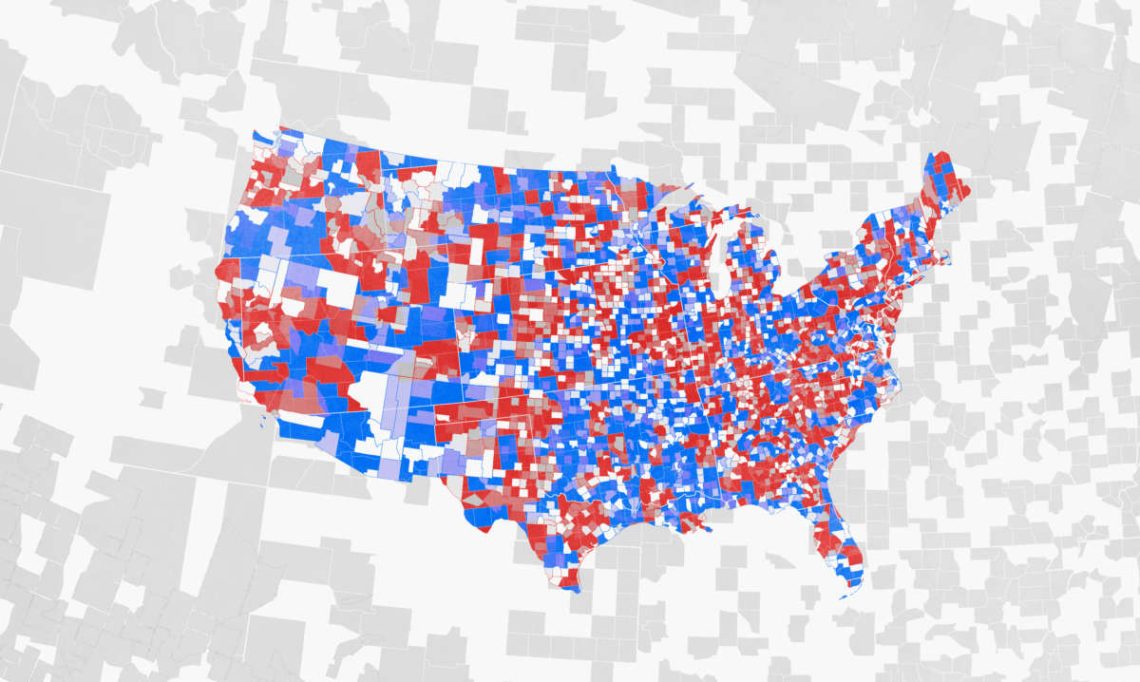
What Is Gerrymandering? The Origins of a Controversial Practice
Gerrymandering refers to the deliberate manipulation of electoral district boundaries to give a political party, incumbent, or group an unfair advantage in elections. This practice occurs during redistricting, the process of redrawing congressional and state legislative districts, typically every ten years after the U.S. Census to reflect population changes and ensure roughly equal population sizes per district as required by the “one person, one vote” principle established in Supreme Court cases like Baker v. Carr (1962), Gray v. Sanders (1963), and Wesberry v. Sanders (1964).
The term gerrymandering itself has a colorful and ironic origin story that dates back to 1812 in Massachusetts. Governor Elbridge Gerry, a Democratic-Republican, signed a redistricting bill that favored his party by consolidating Federalist voters into a few districts. One particularly contorted district in the Boston area resembled a salamander. A famous political cartoon in the Boston Gazette on March 26, 1812, by Elkanah Tisdale (or possibly involving Gilbert Stuart in some accounts) depicted the district as a mythical “Gerry-mander” — a dragon-like creature with claws, wings, and a serpentine body. The portmanteau of “Gerry” and “salamander” stuck, turning a partisan maneuver into a lasting symbol of electoral trickery.
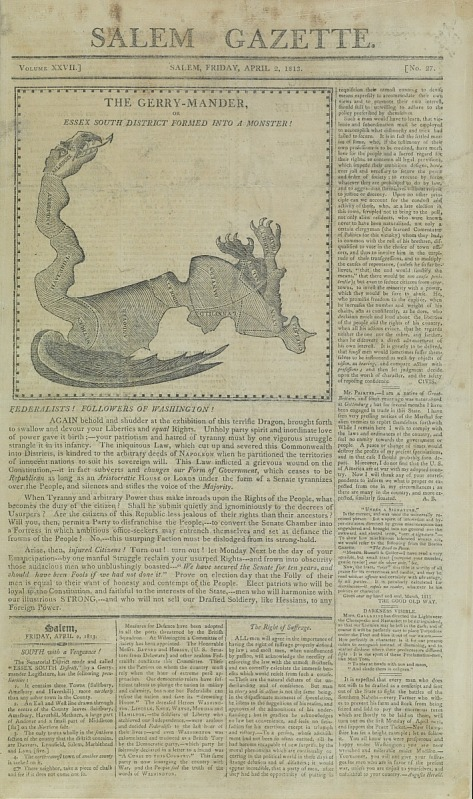
Image: The original 1812 “Gerry-Mander” cartoon from the Boston Gazette, showing the salamander-shaped district. (This historical cartoon vividly illustrates how one oddly shaped district sparked the term still used today.) (Source: Smithsonian Institution / Library of Congress collections)
This early episode highlights a key truth: gerrymandering is not new. Politicians have long sought to “pick their voters” rather than let voters pick their politicians. Modern techniques primarily involve two strategies: packing (concentrating opponents’ voters into a few districts where they win by huge margins but waste surplus votes) and cracking (spreading opponents’ voters thinly across many districts so they cannot form a majority anywhere).
Pros and Cons of Gerrymandering: A Balanced Examination
Advocates sometimes argue that gerrymandering has limited or even neutral effects in certain contexts. Partisan gerrymandering can create “safe seats” that allow representatives to focus on governance without constant campaigning. In theory, it can also protect incumbents from both parties in bipartisan deals, leading to legislative stability. Some analyses, such as those from Brookings, suggest that in recent cycles, the net national impact on House seat distribution has been smaller than often claimed because both parties engage in it where they hold power, partially canceling out effects. Defensive gerrymandering (protecting one’s own seats) is common in competitive environments.
However, the drawbacks of gerrymandering are far more widely documented and concerning. It distorts representation by producing outcomes that do not reflect statewide voter preferences. For example, a party can win a minority of the popular vote yet secure a majority of seats. This reduces electoral competition, leading to more polarized politics as winners in safe districts cater to primary voters rather than moderates. It can dilute the voting power of racial or ethnic minorities (racial gerrymandering), violating the Voting Rights Act in some cases, though the Supreme Court has drawn lines on justiciability for pure partisan claims (Rucho v. Common Cause, 2019).
Gerrymandering also erodes public trust in democracy. When maps appear rigged, voters feel their voices matter less, potentially lowering turnout. It contributes to less responsive legislators and can entrench extremism. Harvard research has shown that while gerrymandering may not drastically shift national partisan balances, it significantly reduces competition and incumbent accountability at the district level.
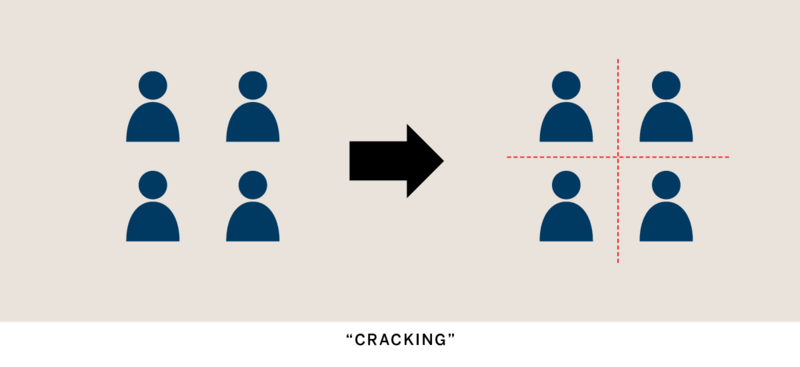
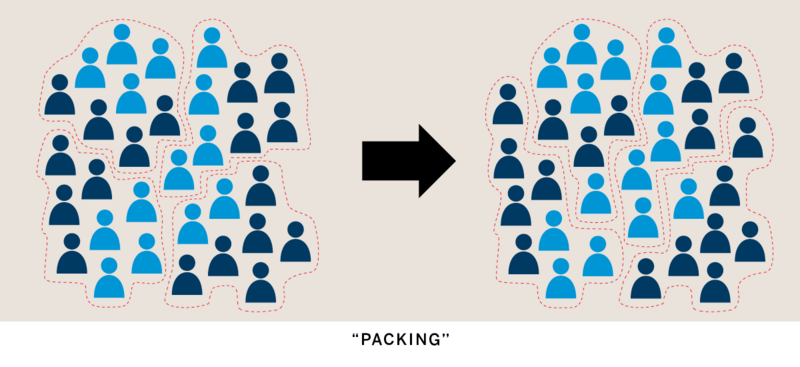
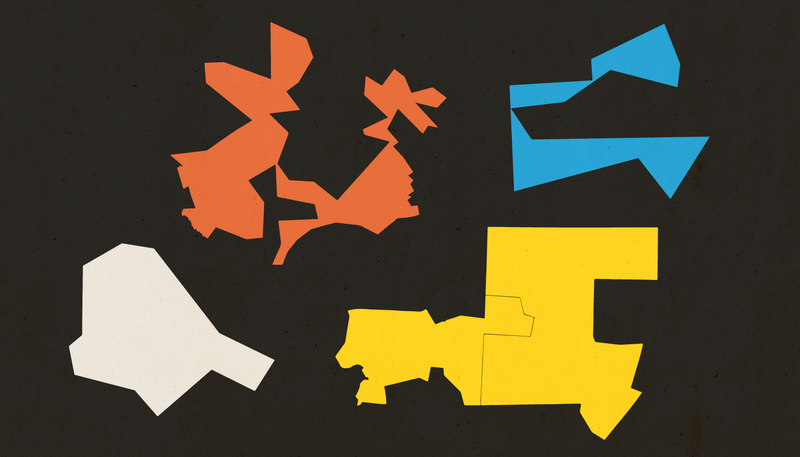
Image: Side-by-side comparison of a compact, neutral district map versus a gerrymandered map using packing and cracking techniques. (This visual demonstrates how seemingly small line adjustments can dramatically alter election outcomes.) (Source: Brennan Center for Justice or similar nonpartisan redistricting analyses)
Current Gerrymandering Efforts: States Changing the Political Landscape in 2025-2026
In a notable escalation, the U.S. is experiencing an unusual wave of mid-decade redistricting ahead of the 2026 midterms — far from the standard post-census cycle. This “redistricting arms race” began with Republican-led efforts in states like Texas, where lawmakers redrew maps to potentially gain up to five additional House seats, a move supported by President Trump and ultimately allowed by the Supreme Court after lower court challenges alleging racial gerrymandering.
Other states actively involved or having implemented new maps include:
- North Carolina, Ohio, and Missouri (Republican advantages, with maps enacted or advanced that could net GOP seats).
- California and Virginia (Democratic efforts, with California voters approving changes potentially adding Democratic seats, and Virginia approving a referendum for a map targeting Republican-held districts).
- Utah saw court-influenced changes favoring Democrats in one analysis.
- Florida has seen discussions under Gov. Ron DeSantis for further Republican gains.
Litigation continues in places like Louisiana, where the Supreme Court recently struck down a map as an unconstitutional racial gerrymander (as of April 2026). Attempts in other states (e.g., New York, Maryland) faced setbacks or stays.
These moves reflect a strategic response to narrow House majorities, with both parties accusing the other of undermining fair representation. Independent commissions in some states aim to curb gerrymandering, but most still leave control with legislatures.
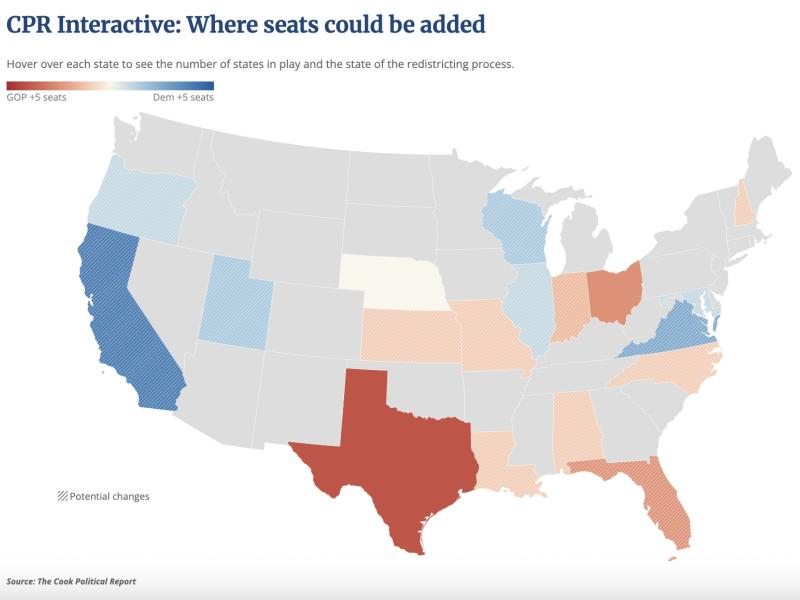
Image: U.S. map highlighting states with recent or ongoing mid-decade redistricting efforts for 2026, color-coded by party advantage. (This overview map captures the national scope of the current battle over electoral boundaries.) (Source: Cook Political Report or Ballotpedia trackers)
The Political Risks of Gerrymandering: Threats to Democratic Stability
The broader political risks of widespread gerrymandering are significant. It can lead to “safe” districts that foster polarization, as representatives face little general-election pressure and focus on primary challenges from the extremes. This dynamic reduces bipartisanship and makes compromise harder in Congress.
By allowing parties to entrench power disproportionate to their vote share, gerrymandering undermines the core democratic idea that elections should reflect the will of the people. It can suppress turnout among groups whose votes are “packed” or “cracked,” and it raises questions about legitimacy when maps are seen as rigged. Over time, this erodes faith in institutions, potentially fueling cynicism or calls for more radical reforms.
Critics argue it threatens multiracial democracy when racial considerations improperly influence lines, while defenders point to the Supreme Court’s view that excessive federal intervention in partisan map-drawing could itself be problematic. The current mid-decade flurry amplifies these risks by turning redistricting into a continuous partisan weapon rather than a decennial administrative task.
One entertaining yet telling anecdote from history: In the 19th century, some states redrew maps so frequently (Ohio did it multiple times in short periods) that elections felt chaotic. Modern software and data have made gerrymandering far more precise and effective — turning what was once crude line-drawing into a sophisticated art of demographic slicing.
Another lighter story involves North Carolina’s infamous “snake-like” districts in past cycles, which courts repeatedly struck down, leading to multiple redraws and public mockery. These episodes show how gerrymandering often backfires in the court of public opinion even if it succeeds short-term electorally.
Conclusion: The Ongoing Battle Over Fair Maps
Gerrymandering remains a deeply embedded feature of American politics, capable of reshaping the political landscape in subtle yet powerful ways. While it offers tactical advantages to those in power, its long-term costs to competition, accountability, and trust are substantial. As states like Texas, California, North Carolina, and others push new maps for 2026, the debate over fair districting continues to evolve through legislation, courts, and voter initiatives.
Reforms such as independent redistricting commissions, mathematical fairness criteria, or multi-member districts are frequently proposed to mitigate these issues. Understanding gerrymandering is essential for informed citizenship in this era of intense partisan map-making.
Sources and Further Reading :
- Brennan Center: Gerrymandering Explained – https://www.brennancenter.org/our-work/research-reports/gerrymandering-explained
- Wikipedia: Gerrymandering (comprehensive history) – https://en.wikipedia.org/wiki/Gerrymandering
- Ballotpedia: 2025–2026 Redistricting – https://ballotpedia.org/Redistricting_ahead_of_the_2026_elections
- Cook Political Report Redistricting Tracker – https://www.cookpolitical.com/redistricting
- Britannica: Gerrymandering Overview – https://www.britannica.com/topic/gerrymandering
- PBS/Newshour: State-by-State Redistricting Look – https://www.pbs.org/newshour/politics/a-state-by-state-look-at-the-narrowing-redistricting-battle-for-the-u-s-house