The United States 5-cent coin, commonly known as the nickel, has a rich history spanning over 150 years. From its origins in the post-Civil War era to modern commemorative designs, this humble coin reflects economic changes, material shortages, and cultural shifts in America. In this detailed guide, we’ll explore the key milestones in the history of the US nickel, backed by verified facts from reliable sources. We’ll also highlight intriguing episodes that add color to its story, making it more than just pocket change.
Whether you’re a coin collector, history enthusiast, or simply curious about US currency, understanding the nickel’s evolution offers insights into American ingenuity and resilience. Let’s dive into the timeline, designs, and notable anecdotes.
Origins of the 5-Cent Coin: From Silver Half Dime to Nickel Alloy
The concept of a 5-cent denomination dates back to the Coinage Act of 1792, which authorized the silver half dime as the first US five-cent piece. Minted from 1794 to 1873 (with interruptions), the half dime was made of silver and featured various designs, including those by engravers like Adam Eckfeldt and Christian Gobrecht. Its fineness was standardized to .900 silver in 1837.
The American Civil War (1861–1865) disrupted the economy, leading to hoarding of precious metals and a shortage of small change. To address this, the US Mint introduced fractional paper currency, but by 1865, Congress sought a more durable solution. The result was the authorization of a base-metal 5-cent coin in 1866, composed of 75% copper and 25% nickel—hence the name “nickel.” This new coin weighed 5 grams and had a diameter of 20.5 mm initially, later standardized to 21.21 mm.
Interesting Episode: During the war, the five-cent fractional note controversially featured Spencer M. Clark’s portrait (the Treasury Register), leading Congress to ban living persons on US currency—a rule still in effect today. This scandal indirectly paved the way for the nickel’s creation.
The Shield Nickel (1866–1883): The First True Nickel
Designed by James B. Longacre, the Shield nickel was the inaugural design for the copper-nickel alloy coin. The obverse featured a shield with stars and stripes, while the reverse displayed a “5” encircled by stars and rays (the rays were removed in 1867 to simplify production). Minted primarily in Philadelphia, production slowed in the 1870s due to surpluses, with no circulating coins struck in 1877 or 1878 (only proofs).
The coin was criticized for its “ugly” appearance and production difficulties, including rapid die wear. Despite this, it circulated alongside the silver half dime until 1873.
Fascinating Fact: Early nickels were sometimes confused with other denominations due to design changes, leading to public frustration. In one quirky episode, the hard alloy made striking crisp details challenging, resulting in many “weak strike” coins that collectors now prize.

Nickel Coins: Exploring the 5-Cent Marvel
Image: An example of the Shield Nickel design, showcasing its historical origins (public domain source).
Liberty Head Nickel (1883–1913): The “V” Nickel and a Counterfeiting Scandal
Charles Barber’s Liberty Head nickel, often called the “V” nickel for the Roman numeral on the reverse, replaced the Shield design. The obverse depicted Lady Liberty, and the reverse featured a “V” in a wreath. Production began in 1883, but the initial version omitted the word “CENTS,” leading to a infamous counterfeiting scheme.
Intriguing Episode: Racketeers gilded these nickels to resemble $5 gold pieces, fooling merchants. This “racketeer nickel” scandal prompted a quick redesign to add “CENTS” mid-1883. Even more legendary is the 1913 Liberty Head nickel—only five were struck without authorization, making it one of the rarest US coins. One sold for $4.2 million in 2022!
Minted in Philadelphia, Denver, and San Francisco (from 1912), production dipped during economic slumps like the Panic of 1893.

Nickel Coins: Exploring the 5-Cent Marvel
Image: The Liberty Head Nickel, famous for its “V” reverse and scandalous history (public domain).
Buffalo Nickel (1913–1938): Iconic American Symbolism
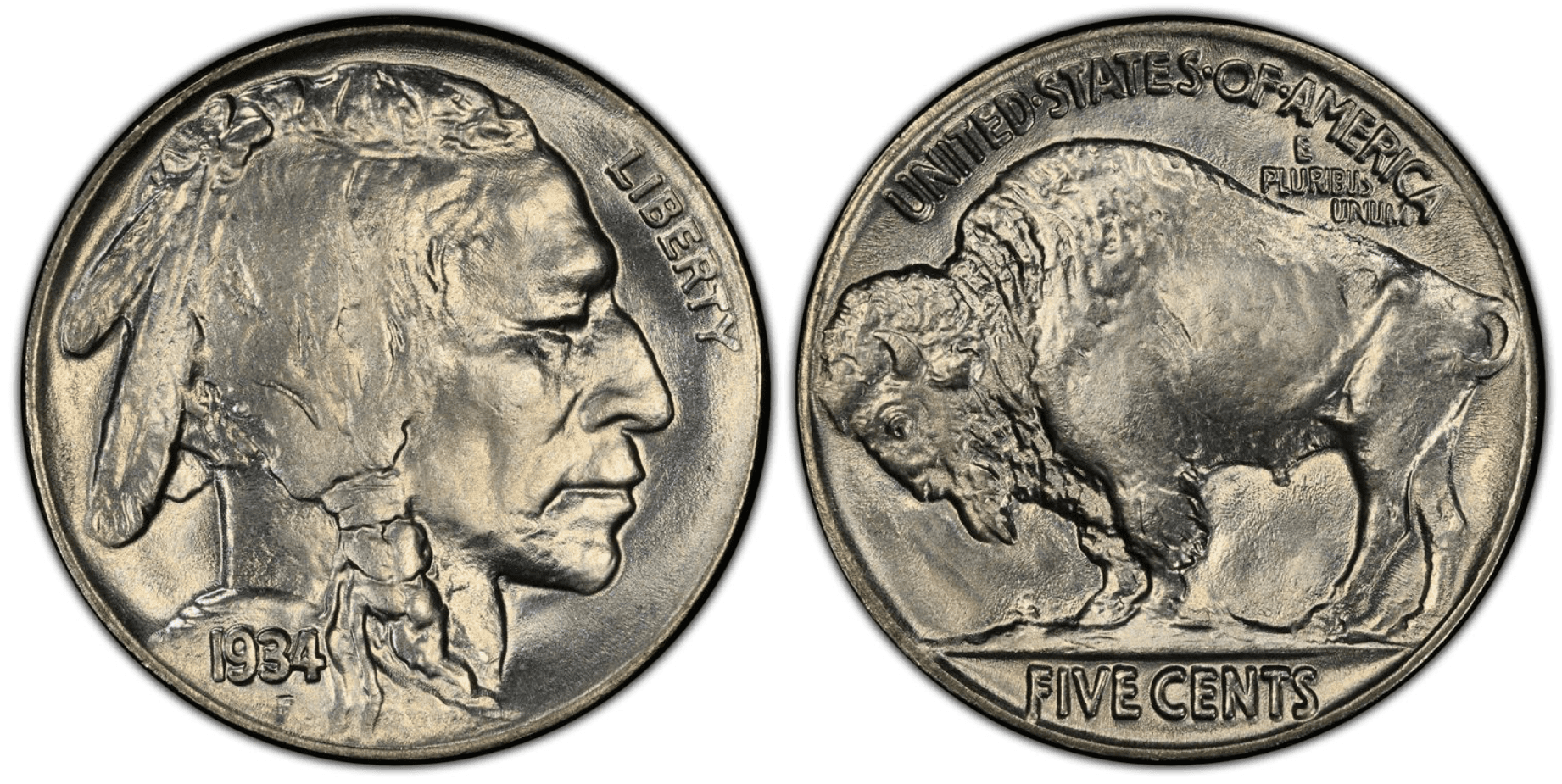
James Earle Fraser’s Buffalo nickel captured the American West with a Native American profile on the obverse (inspired by real chiefs like Iron Tail) and a bison on the reverse (modeled after Black Diamond from the Bronx Zoo). Introduced in 1913, it had two types: Type I with a mound under the bison and Type II with a flat ground for better wear resistance.
The date wore off quickly in circulation, frustrating users. Production ended in 1938, with no coins minted in 1922, 1932, or 1933 due to the Great Depression.
Fun Anecdote: During the Great Depression, “hobo nickels” emerged—transient artists carved intricate designs into Buffalo nickels, turning them into folk art. Some fetch high prices today as collectibles.
1934 Buffalo Nickel Value
Image: The Buffalo Nickel, embodying early 20th-century American heritage (public domain).
Jefferson Nickel (1938–Present): Wartime Changes and Modern Updates
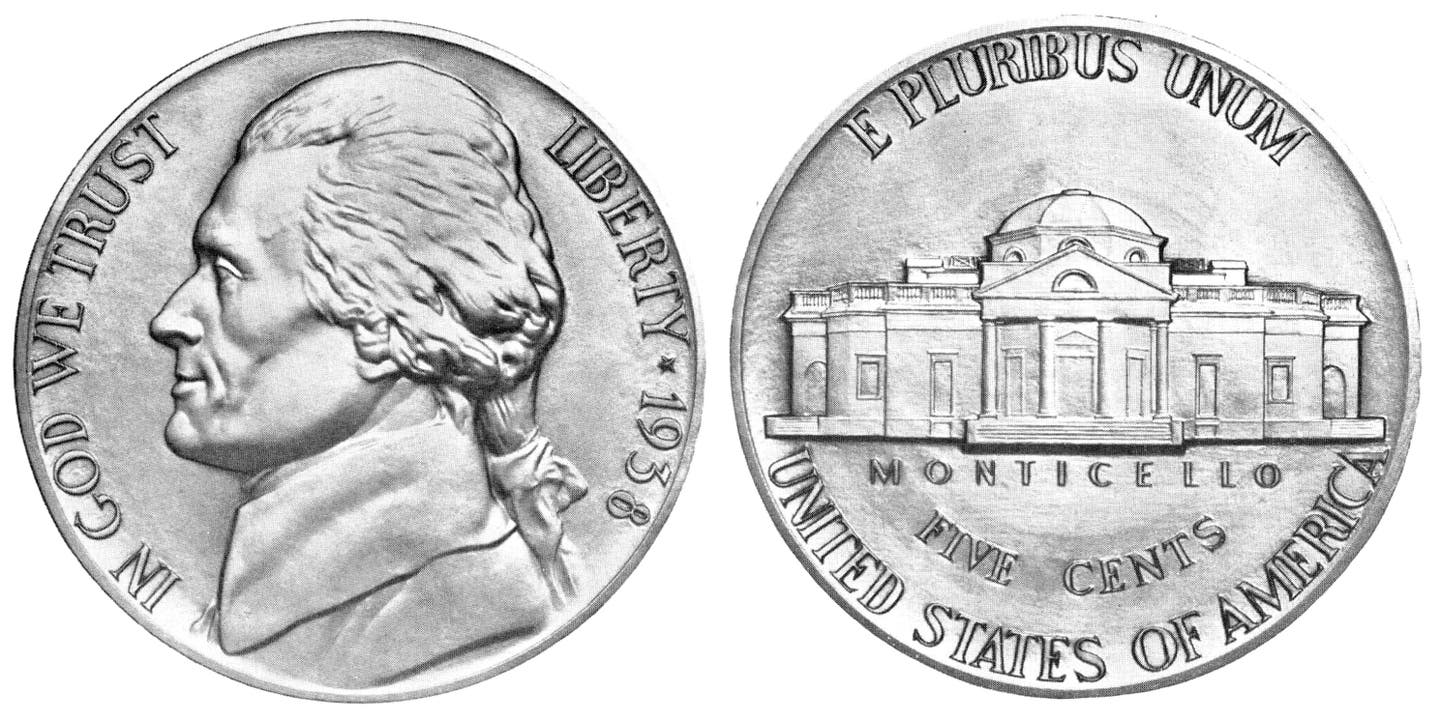
Felix Schlag’s Jefferson nickel debuted in 1938, featuring Thomas Jefferson on the obverse (based on a Jean-Antoine Houdon bust) and his Monticello estate on the reverse. It has remained the standard design, with the composition reverting to 75% copper and 25% nickel post-World War II.
During WWII (1942–1945), nickel shortages led to “War Nickels” made of 56% copper, 35% silver, and 9% manganese, identifiable by large mint marks above Monticello. These contained actual silver (about 1.75 grams), making them valuable to melt during shortages.
Notable Episode: In 2004–2005, the Westward Journey series commemorated the Lewis and Clark Expedition with temporary designs, including a forward-facing Jefferson and reverses like a bison and ocean view quote. The original Monticello returned in 2006, but with a new Jefferson portrait.
Today, the Jefferson nickel continues in circulation, with no major changes since 2006.
The United States Nickel – Numismatic News
Image: The classic Jefferson Nickel, a staple of modern US currency (public domain).
Key Facts and Composition Timeline
| Period | Design | Composition | Key Changes |
|---|---|---|---|
| 1866–1883 | Shield | 75% Cu, 25% Ni | Rays removed in 1867 |
| 1883–1913 | Liberty Head | 75% Cu, 25% Ni | “CENTS” added mid-1883 |
| 1913–1938 | Buffalo | 75% Cu, 25% Ni | Type II in 1913 for durability |
| 1938–Present | Jefferson | 75% Cu, 25% Ni (except 1942–1945: 56% Cu, 35% Ag, 9% Mn) | Westward Journey variants 2004–2005 |
The nickel’s enduring 5-gram weight and 21.21 mm diameter have made it a consistent part of US coinage.
Why the Nickel Endures: Cultural and Economic Impact
Beyond its monetary value, the nickel symbolizes American history—from Civil War recovery to WWII sacrifices. Collectors hunt rarities like the 1913 Liberty Head, while everyday users appreciate its reliability. As costs rise (it now costs more than 5 cents to produce), debates continue about its future, but for now, it remains a pocket-sized piece of heritage.