Every June, a single spreadsheet manages to rattle university presidents, immigration lawyers, and hopeful 17-year-olds all at once. This year was no exception. On June 18, 2026, the London-based analytics firm Quacquarelli Symonds (QS) released the QS World University Rankings 2027, its 23rd edition of the world’s most-cited global university league table — and one of the loudest storylines to emerge from it was a quiet, boring-sounding number: 14. That is how many American universities landed inside the global top 50, more than any other country by a wide margin.
But a number without context is just trivia. This post walks through, in detail, who QS actually is, how the QS World University Rankings 2027 table was built, the full top 50 list across every country, and then a deep, source-checked look at each of the 14 US institutions that made the cut — including the surprising twists, the historic slides, and a few genuinely fun campus stories along the way.
Who Is Behind the QS World University Rankings 2027?
Quacquarelli Symonds — usually shortened to “QS” — is a British higher-education analytics and services company headquartered in London, with additional offices across Europe, Asia, and the Americas. The company was founded in 1990 by Nunzio Quacquarelli, who started it as a student project while completing his MBA at the Wharton School at the University of Pennsylvania. Quacquarelli actually won the MootCorp business plan competition that year while representing Wharton, beating out teams from Harvard, Stanford, and the London Business School — a nice bit of foreshadowing, since decades later his company would be the one ranking those very schools.
For its first fourteen years, QS was mostly known for MBA fairs, study-abroad guides, and career publications aimed at international students. In 2004, QS partnered with Times Higher Education (THE) magazine to launch the original THE-QS World University Rankings, one of the first attempts to rank universities globally rather than just nationally. That partnership ended in 2010, and each organization has published its own separate rankings ever since — QS continuing under the QS World University Rankings name, and THE running its own, differently weighted table. This split is worth knowing, because it explains why QS, THE, and other systems like the Academic Ranking of World Universities (ARWU/Shanghai Ranking) and U.S. News Best Global Universities often rank the very same school quite differently in the same year — they are measuring different things.
QS has grown considerably since then. It acquired Hobsons Solutions’ international division in 2017, the counselling platform StudentApply in 2021, and the career-navigation platform 1Mentor in 2024. As of its most recent public filing, the company reported turnover of roughly £50.5 million. Nunzio Quacquarelli now serves as company president, while Jessica Turner runs day-to-day operations as CEO. Today QS says it works with more than 2,500 universities and reaches around 70 million students and professionals a year through its rankings, fairs, and digital platforms.
How the QS World University Rankings 2027 Methodology Works
The QS World University Rankings 2027 evaluated 1,504 institutions across more than 100 higher-education systems worldwide — the largest edition in the ranking’s history, including 98 brand-new entrants. Every university receives a composite score out of 100, built from nine weighted indicators grouped into five broad categories:
- Research & Discovery (50%) — Academic Reputation (30%) and Citations per Faculty (20%)
- Employability & Outcomes (20%) — Employer Reputation (15%) and Employment Outcomes (5%)
- Global Engagement (15%) — International Faculty Ratio (5%), International Research Network (5%), and International Student Ratio (5%)
- Learning Experience (10%) — Faculty/Student Ratio (10%)
- Sustainability (5%) — Institutional Sustainability Practices (5%)
Notably, this edition quietly introduced a new International Student Diversity indicator that currently carries zero weight in the scoring — a metric QS appears to be trialing before it eventually counts toward a school’s total score in a future edition. Academic Reputation and Employer Reputation together still make up nearly half of every university’s final result, which is why QS rankings tend to reward globally recognized, historically prestigious institutions more heavily than, say, a ranking built purely from citation counts or Nobel Prizes (like ARWU).
The Full QS World University Rankings 2027 Top 50
Before zooming into the American picture, here is the complete top 50 of the QS World University Rankings 2027, spanning twelve countries and territories:
| Rank | University | Country/Territory |
|---|---|---|
| 1 | Massachusetts Institute of Technology (MIT) | 🇺🇸 United States |
| =2 | Imperial College London | 🇬🇧 United Kingdom |
| =2 | Stanford University | 🇺🇸 United States |
| 4 | University of Oxford | 🇬🇧 United Kingdom |
| 5 | Harvard University | 🇺🇸 United States |
| 6 | University of Cambridge | 🇬🇧 United Kingdom |
| 7 | California Institute of Technology (Caltech) | 🇺🇸 United States |
| =8 | ETH Zurich | 🇨🇭 Switzerland |
| =8 | UCL (University College London) | 🇬🇧 United Kingdom |
| 10 | National University of Singapore (NUS) | 🇸🇬 Singapore |
| 11 | The University of Hong Kong (HKU) | 🇭🇰 Hong Kong SAR |
| 12 | Nanyang Technological University (NTU) | 🇸🇬 Singapore |
| 13 | Peking University | 🇨🇳 Mainland China |
| 14 | Tsinghua University | 🇨🇳 Mainland China |
| 15 | University of Pennsylvania | 🇺🇸 United States |
| =16 | Cornell University | 🇺🇸 United States |
| =16 | Yale University | 🇺🇸 United States |
| 18 | The Chinese University of Hong Kong (CUHK) | 🇭🇰 Hong Kong SAR |
| 19 | University of New South Wales (UNSW Sydney) | 🇦🇺 Australia |
| =20 | Johns Hopkins University | 🇺🇸 United States |
| =20 | University of California, Berkeley | 🇺🇸 United States |
| =22 | EPFL Lausanne | 🇨🇭 Switzerland |
| =22 | University of Melbourne | 🇦🇺 Australia |
| 24 | University of Chicago | 🇺🇸 United States |
| 25 | Technical University of Munich | 🇩🇪 Germany |
| 26 | Fudan University | 🇨🇳 Mainland China |
| 27 | Princeton University | 🇺🇸 United States |
| 28 | University of Sydney | 🇦🇺 Australia |
| 29 | Australian National University (ANU) | 🇦🇺 Australia |
| 30 | McGill University | 🇨🇦 Canada |
| 31 | Monash University | 🇦🇺 Australia |
| 32 | University of Toronto | 🇨🇦 Canada |
| 33 | Hong Kong University of Science and Technology (HKUST) | 🇭🇰 Hong Kong SAR |
| 34 | Université PSL | 🇫🇷 France |
| 35 | University of Edinburgh | 🇬🇧 United Kingdom |
| 36 | Shanghai Jiao Tong University | 🇨🇳 Mainland China |
| 37 | King’s College London | 🇬🇧 United Kingdom |
| 38 | Seoul National University | 🇰🇷 South Korea |
| 39 | The University of Tokyo | 🇯🇵 Japan |
| =40 | University of Manchester | 🇬🇧 United Kingdom |
| =40 | University of Queensland | 🇦🇺 Australia |
| 42 | Yonsei University | 🇰🇷 South Korea |
| =43 | Columbia University | 🇺🇸 United States |
| =43 | Institut Polytechnique de Paris | 🇫🇷 France |
| =45 | Northwestern University | 🇺🇸 United States |
| =45 | University of British Columbia | 🇨🇦 Canada |
| 47 | Zhejiang University | 🇨🇳 Mainland China |
| 48 | Delft University of Technology | 🇳🇱 Netherlands |
| 49 | University of California, Los Angeles (UCLA) | 🇺🇸 United States |
| 50 | Hong Kong Polytechnic University (PolyU) | 🇭🇰 Hong Kong SAR |
Count the flags and the pattern jumps out immediately: the United States holds 14 of the 50 seats — MIT, Stanford, Harvard, Caltech, UPenn, Cornell, Yale, Johns Hopkins, Berkeley, Chicago, Princeton, Columbia, Northwestern, and UCLA. The United Kingdom is next with seven (Imperial, Oxford, Cambridge, UCL, Edinburgh, King’s College London, Manchester), followed by Australia with six, Hong Kong with five, and China with four. Across the full ranking of 1,504 institutions, the US still has the single largest footprint of any country — 184 ranked universities in total, ahead of the UK’s 93 and mainland China’s 85 — even though that US count actually shrank slightly from 192 the year before.
Deep Dive: The 14 US Universities in the QS World University Rankings 2027 Top 50
This is the heart of the QS World University Rankings 2027 story for an American audience: which schools made it, how their positions moved compared to last year, and what is actually going on behind each number.
1. MIT — Rank #1 (15th Consecutive Year)
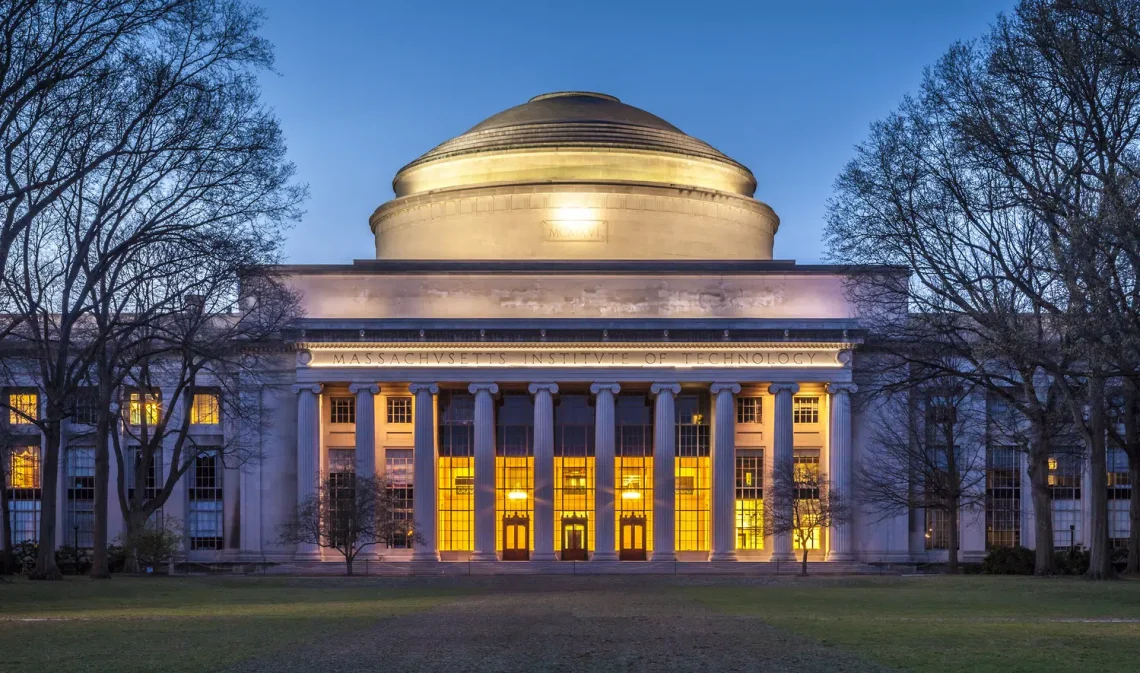
MIT has now held the #1 spot in the QS World University Rankings for fifteen consecutive years, a streak QS itself has publicly confirmed. Founded in 1861, MIT’s motto, Mens et Manus (“Mind and Hand”), captures its founding idea: that technical education should be tied directly to hands-on practice, not just theory. One of the more charming side notes about MIT is its decades-long “hacking” culture — students have a long tradition of elaborate, harmless pranks, from placing a full-size campus police car on top of the Great Dome to turning the dome itself into a giant R2-D2. It is a strange contrast: one of the most rigorously quantitative universities on Earth is also famous for whimsical, engineering-grade practical jokes.
2. Stanford University — Tied for #2
Stanford rose from #3 last year to share the #2 spot this year, tied with Imperial College London. Founded in 1885 by railroad magnate Leland Stanford and his wife Jane in memory of their son, who died of typhoid fever at age 15, the university’s official motto is Die Luft der Freiheit weht (“The wind of freedom blows”). Stanford’s proximity to what became Silicon Valley is not a coincidence — the university actively encouraged faculty and students to commercialize their research starting in the mid-20th century, and alumni or former staff went on to found or co-found companies including Google, Hewlett-Packard, Nike, and Netflix.
3. Harvard University — Rank #5
Harvard, founded in 1636, is older than the United States itself by 140 years — it predates the Declaration of Independence, the US Constitution, and even the founding of most European research universities still operating today. QS credits Harvard with leading globally across four separate ranking indicators this year. Its 21 million-plus volume library system is the largest academic library in the world, and its alumni list includes eight US presidents.
4. Caltech — Rank #7 (Best Result Since 2023)
Caltech is the smallest school on this entire top-50 list by a wide margin — it enrolls roughly 2,500 students in total, undergraduate and graduate combined, compared to tens of thousands at most other top-ranked universities. Despite (or perhaps because of) its size, Caltech has one of the highest Nobel Prize counts per capita of any institution in the world. Its close relationship with NASA’s Jet Propulsion Laboratory, which Caltech manages under contract, means Caltech researchers have had a direct hand in nearly every major US planetary mission, from Voyager to the Mars rovers.
5. University of Pennsylvania — Rank #15
Penn was founded in 1740 with direct involvement from Benjamin Franklin, who wanted a school that trained students for both scholarship and practical civic life rather than the clergy-focused model common at the time. Its Wharton School, founded in 1881, was the first collegiate business school established anywhere in the world — a fact that still surprises people, given how many business schools now claim to be “the original.”
6 & 7. Cornell University and Yale University — Tied at #16
Both Cornell and Yale share the #16 spot this year, with Yale climbing back into the global top 20 after slipping outside it the previous cycle. Cornell, founded in 1865, is unusual among elite US universities for its founding motto: “I would found an institution where any person can find instruction in any study” — a deliberately egalitarian statement compared to the more exclusive university culture of its era. Yale, founded in 1701, is nearly a century older, and its secret societies — most famously Skull and Bones — have fueled popular fascination (and more than a few conspiracy theories) for well over a hundred years.
8 & 9. Johns Hopkins University and UC Berkeley — Tied at #20
Both schools re-entered (or newly entered) the global top 20 this year. Johns Hopkins, founded in 1876 with a bequest from Baltimore merchant and philanthropist Johns Hopkins, is widely credited as the first true research university in the United States — the model where faculty are expected to conduct original research, not just teach, later copied by nearly every major American university. UC Berkeley, founded in 1868 as the flagship of the University of California system, is a fully public institution, which makes its top-20 global finish notable: it competes with — and regularly beats — private universities that charge many times its in-state tuition. Berkeley was also the birthplace of the 1964 Free Speech Movement, a student protest that reshaped how American universities think about campus political expression.
10. University of Chicago — Rank #24 (Steepest Fall in the Top 25)
This is the most dramatic American storyline in the entire QS World University Rankings 2027 edition. The University of Chicago dropped 11 places, from 13th to 24th, the steepest single-year decline among any university in the global top 25. Analysts who reviewed the underlying indicator data point to declines in areas like International Research Network and Citations per Faculty rather than any actual change in teaching quality — a reminder that a ranking can move sharply even when a university’s day-to-day academic life stays the same. Chicago has long had a self-deprecating unofficial motto among its own students — “where fun goes to die” — a joking nod to its intensely academic, discussion-heavy culture built around the famous Chicago “Core” curriculum. Despite the rankings dip, Chicago’s economics department remains one of the most influential in the world, having shaped what economists call the “Chicago School” of free-market economic thought.
11. Princeton University — Rank #27
Princeton, founded in 1746, is the only Ivy League school without a law school or a medical school — a deliberate historical choice to stay focused on undergraduate liberal-arts education and doctoral research. Albert Einstein worked next door to Princeton’s campus for over 20 years at the Institute for Advanced Study, an independent research center closely associated with — but formally separate from — the university itself, a distinction that still confuses plenty of visitors.
12. Columbia University — Rank #43
Columbia, chartered in 1754 as King’s College under a royal charter from King George II, is the oldest institution of higher education in the state of New York. It dropped five places this year. Columbia administers the Pulitzer Prizes, journalism and the arts’ most prestigious American award, even though the prize itself is not part of any single Columbia degree program — the university simply hosts the independent board that selects winners each year.
13. Northwestern University — Rank #45
Northwestern, founded in 1851 in Evanston, Illinois, is regularly ranked among the strongest research universities in the Big Ten athletic conference, a group better known nationally for football than academics. Its Medill School of Journalism is one of the most competitive journalism programs in the country, and Northwestern’s Kellogg School of Management consistently ranks among the top MBA programs worldwide.
14. UCLA — Rank #49
UCLA rounds out the American top 50, founded in 1919 as the second campus of the University of California system. It has the distinction of being, by raw application volume, one of the most applied-to universities in the entire United States, receiving well over 130,000 undergraduate applications in recent cycles. Athletically, UCLA also holds more NCAA team championships than any other university in the country, giving it a rare combination of elite academics and elite sports culture in the same public-university package.
The Bigger Story: Why Is the US Slipping Beneath the Surface?
Here is where the QS World University Rankings 2027 numbers get genuinely interesting, and worth reading carefully rather than skimming. On the surface, American dominance looks intact — 14 schools in the top 50, nine schools in the top 20, and MIT, Stanford, Harvard, and Caltech occupying four of the global top ten. But look one level deeper into the underlying indicator data, and a different pattern shows up: roughly two-thirds of all ranked US institutions saw at least some decline in their position this year, even while the very top schools stayed remarkably stable.
Education-sector analysts tracking the release have pointed to a mix of possible causes behind this broader softness — tightened international-student visa policy, cuts to federal research funding at several agencies, and a proposed steep increase to H-1B visa sponsorship fees that would affect how easily US universities can retain international graduates and researchers. QS’s own public commentary framed it as a signal that global perceptions of the US as a study and research destination may be shifting, without pinning the change on any single cause. Meanwhile, the mirror-image trend is happening in East Asia: mainland Chinese institutions moved up an average of more than 26 places this year, and Hong Kong’s five ranked flagship universities all climbed simultaneously — not one of them fell. Whether this represents a temporary wobble or the start of a longer-term shift in global higher-education competitiveness is something only the next few editions of the ranking will be able to answer.
It’s worth remembering, too, that a QS rank moving up or down by five, ten, or even fifteen places rarely reflects an actual change in what happens inside a lecture hall. These shifts are usually driven by reputation-survey responses, citation counts, or faculty ratios recalculated year to year — useful signals in aggregate, but not a precise verdict on teaching quality at any single institution.