In a stunning announcement on February 8, 2026, Elon Musk declared that SpaceX has shifted its primary focus from Mars to Moon Exploration. The company is now racing to build a “self-growing city” on the Moon within the next decade—a bold pivot that redefines humanity’s path to the stars. This isn’t a retreat from Mars; it’s a smarter, faster route to making multi-planetary life a reality.
Moon Exploration has always been the overlooked stepping stone. Closer, more accessible, and ripe with resources, it offers the perfect proving ground for the technologies that will one day sustain us on the Red Planet. In this deep dive, we explore the rich history of Moon Exploration, the hard lessons from Mars missions, Musk’s strategic reasoning, the national security stakes, the economic windfall for America, and a realistic timeline for when Moon Exploration could transform from dream to destiny.

(Image: Elon Musk gazing at the Moon, symbolizing his dramatic shift toward Moon Exploration as the new priority for SpaceX. ibtimes.co.uk)
The Golden Age of Moon Exploration: Triumphs That Defined a Generation
Moon Exploration began in the shadows of the Cold War. On September 14, 1959, the Soviet Union’s Luna 2 became the first human-made object to reach the lunar surface—crashing near the crater Autolycus in a blaze of glory. But here’s the fun part: Soviet engineers had a cheeky plan. They packed the probe with tiny pentagonal pennants bearing the USSR emblem, designed to scatter across the surface like lunar confetti. It was the ultimate “We were here first” flex, and it lit a fire under America’s space program.
Fast-forward to July 20, 1969. Apollo 11 touched down in the Sea of Tranquility. Neil Armstrong’s “one small step” wasn’t just poetic—it was the culmination of a $25 billion (in today’s dollars) national effort. But the real drama came earlier. During the lunar module’s descent, alarms blared: “1202” and “1201” program alarms. The computer was overloaded. Flight director Gene Kranz and his team in Houston had seconds to decide. They trusted the software and let Armstrong land manually. That split-second call saved the mission and cemented Moon Exploration as humanity’s greatest engineering feat.
Then there’s Apollo 13 in 1970—the “successful failure” that became legend. An oxygen tank exploded en route, forcing the crew to use the lunar module as a lifeboat. Commander Jim Lovell’s calm radio call—”Houston, we’ve had a problem”—understated the terror. The crew survived by rationing power, scrubbing CO2 with jury-rigged filters, and slingshotting around the Moon for a free return. Hollywood turned it into a blockbuster, but the real heroes were the ground crew who invented solutions on the fly.

(Image: Buzz Aldrin on the lunar surface during Apollo 11, one of the most iconic moments in Moon Exploration history. kids.nationalgeographic.com)
By the time Apollo 17 wrapped up in 1972, Moon Exploration had delivered 382 kg of samples, seismic data, and proof that the Moon was once geologically active. Then, silence—for 50 years. Until now.
Mars Exploration: A Brutal Teacher of Resilience and Humility
If Moon Exploration was a sprint, Mars Exploration has been a punishing marathon. Since 1960, over 60 missions have targeted the Red Planet, with a success rate hovering around 50%. Early Soviet attempts were disasters: Mars 1 lost contact after 65 million miles. The U.S. Mariner 4 finally succeeded in 1965, sending back grainy photos of a cratered, dead world that shattered dreams of canals and little green men.
The 1970s brought Viking 1 and 2—the first successful landers. They scooped soil, tested for life (inconclusive), and beamed back the first color panoramas. But the real stars were the rovers. Spirit and Opportunity, twins that landed in 2004, were supposed to last 90 days. Opportunity drove 28 miles over 14 years, surviving dust storms that would bury a lesser machine. When it finally went silent in 2018, NASA held a tearful “goodbye” ceremony.
The infamous failures make for great stories too. In 1999, the Mars Climate Orbiter disintegrated in the atmosphere because one team used metric units and another used imperial. “The metric mix-up” cost $327 million and became a textbook case of “measure twice, cut once.” Then there was the 2003 Beagle 2 lander from Europe—found years later, its solar panels partially deployed like a half-open umbrella. It had bounced on landing and gotten stuck.

(Image: NASA’s Perseverance rover on Mars, capturing the rugged beauty and challenges of Mars Exploration. jpl.nasa.gov)
Today’s Perseverance rover is drilling for ancient life signs and caching samples for a future return mission. But the lesson is clear: Mars is unforgiving. The 6-month trip, 20-minute communication delays, and rare launch windows every 26 months make rapid iteration impossible. That’s why Musk’s pivot to Moon Exploration makes perfect sense.
Why Moon Exploration is Now the Overriding Priority: Speed, Iteration, and Survival
Musk’s February 2026 X thread was crystal clear: “The overriding priority is securing the future of civilization and the Moon is faster.”
Moon Exploration allows launches every 10 days with a 2-day transit. Mars? Only every 26 months, with a 6-month voyage. That means SpaceX can test, fail, learn, and improve at a blistering pace on the Moon—10 times faster than Mars. A self-sustaining lunar city could be “self-growing” (using local resources for fuel, habitats, and manufacturing) in under 10 years. Mars? 20+ years, at best.
Musk also dropped a chilling rationale: What if a catastrophe on Earth—asteroid, pandemic, war—cuts off resupply? A lunar outpost is close enough to sustain itself quickly. Mars is too far to save in time. It’s not abandoning Mars; it’s using Moon Exploration as the ultimate dress rehearsal.
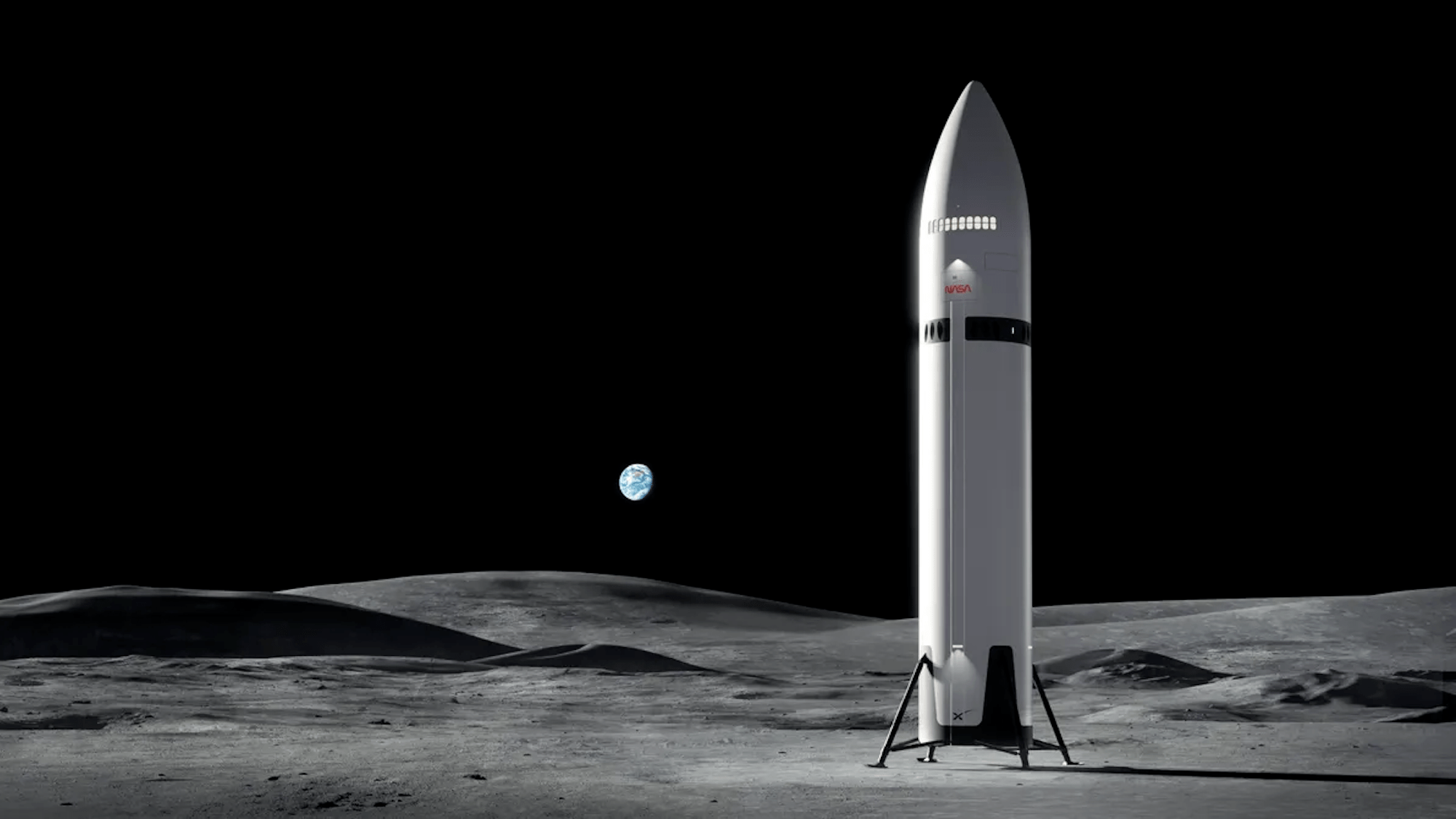
(Image: Starship concept art on the lunar surface—SpaceX’s vision for practical Moon Exploration infrastructure. popsci.com)
The Strategic and National Security Imperative of Moon Exploration
Moon Exploration isn’t just scientific—it’s geopolitical chess. China is accelerating its lunar program with crewed landings targeted for 2030. The Moon’s south pole holds billions of tons of water ice—perfect for rocket fuel and life support. Whoever controls cislunar space (the region between Earth and Moon) controls the high ground of the 21st century.
The U.S. Space Force calls the Moon “key terrain.” Moon Exploration secures America’s dominance in space logistics, denies adversaries resource monopolies, and positions the U.S. as the indispensable partner for global lunar commerce. Helium-3, abundant on the Moon, could power fusion reactors back on Earth—clean energy independence on a planetary scale.
Fun fact: In the 1960s, the U.S. even considered nuking the Moon to “show strength” (Project A119). Thankfully, saner heads prevailed, but it shows how Moon Exploration has always been tied to power.
How Moon Exploration Will Supercharge U.S. Security and Economy
Economically, Moon Exploration is a trillion-dollar catalyst. Lunar mining, in-situ resource utilization (ISRU), and space manufacturing could spawn entirely new industries. Imagine 3D-printing habitats from regolith, or building solar power satellites in lunar orbit to beam clean energy to Earth.
For America, the benefits are massive: Hundreds of thousands of high-tech jobs in aerospace, robotics, AI, and materials science. NASA’s Artemis program alone is projected to generate $1.5 trillion in economic output by 2035. Private players like SpaceX will accelerate this, turning the Moon into a logistics hub for deeper space.
Security-wise, a robust Moon Exploration presence deters aggression in space. It creates resilient supply chains immune to terrestrial disruptions and fosters international alliances through the Artemis Accords—already signed by 50+ nations.
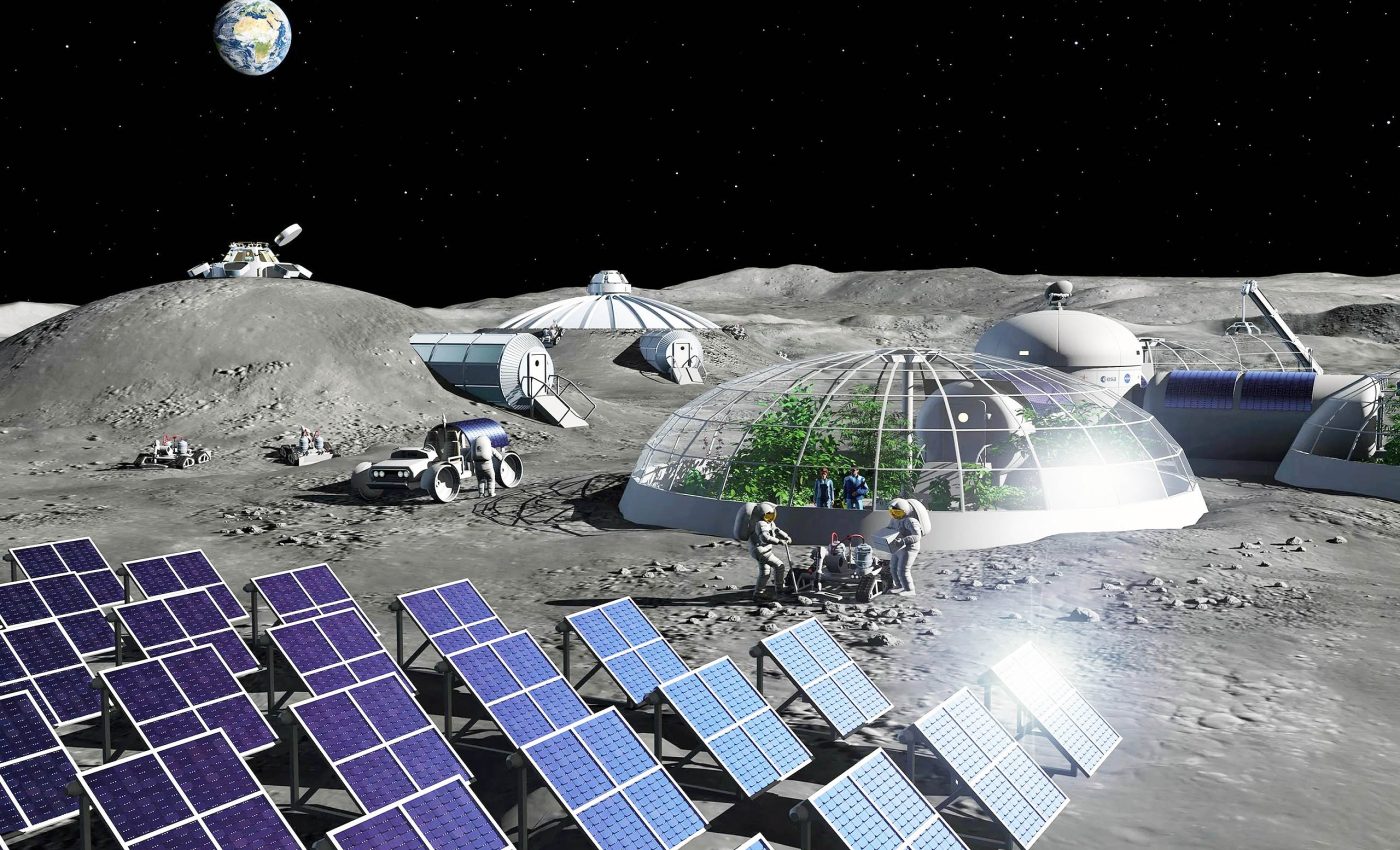
(Image: Artist’s concept of a future lunar base under the Artemis program, highlighting the long-term vision of Moon Exploration. earth.com)
The Timeline for Moon Exploration: From 2026 to a Thriving Lunar City
- March 2026: Artemis II—four astronauts (including Canada’s Jeremy Hansen) fly around the Moon in Orion. First crewed deep-space mission in 50+ years.
- 2027-2028: Artemis III—Starship lands the first humans on the lunar south pole since 1972.
- 2028 onward: SpaceX begins uncrewed cargo runs, then crewed outposts. Reusable Starship flights every few weeks.
- Early 2030s: Permanent lunar base with ISRU fuel production. Musk’s “self-growing city” begins to take shape.
- Mid-2030s: Parallel Mars missions ramp up, using lunar lessons to slash timelines.
Delays are possible—space is hard—but Starship’s rapid testing cadence is closing the gap fast.
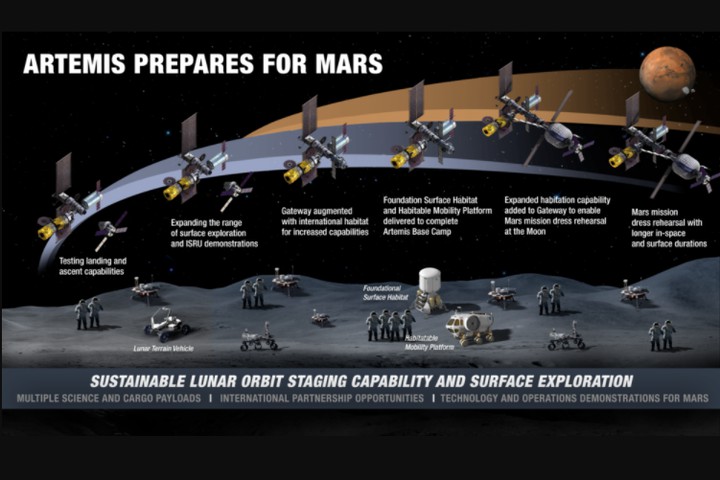
(Image: NASA infographic showing how Moon Exploration via Artemis prepares the way for Mars missions. herox.com)
The Moon Calls: A New Chapter in Human Destiny
Elon Musk’s pivot to Moon Exploration isn’t a detour—it’s the fastest, safest, and most strategic path to becoming a spacefaring civilization. By mastering Moon Exploration first, we gain the tools, the knowledge, and the momentum to reach Mars and beyond. America stands to lead this new space economy, bolstering its security, economy, and place in history.
The Moon has waited patiently for 50 years. Now, it’s time to return—and this time, to stay.